8 Best Amazon Search Data APIs for U.S. Retail Teams (2026)
Compare keyword results, location controls and billing units before building a visibility dashboard.

7 min read
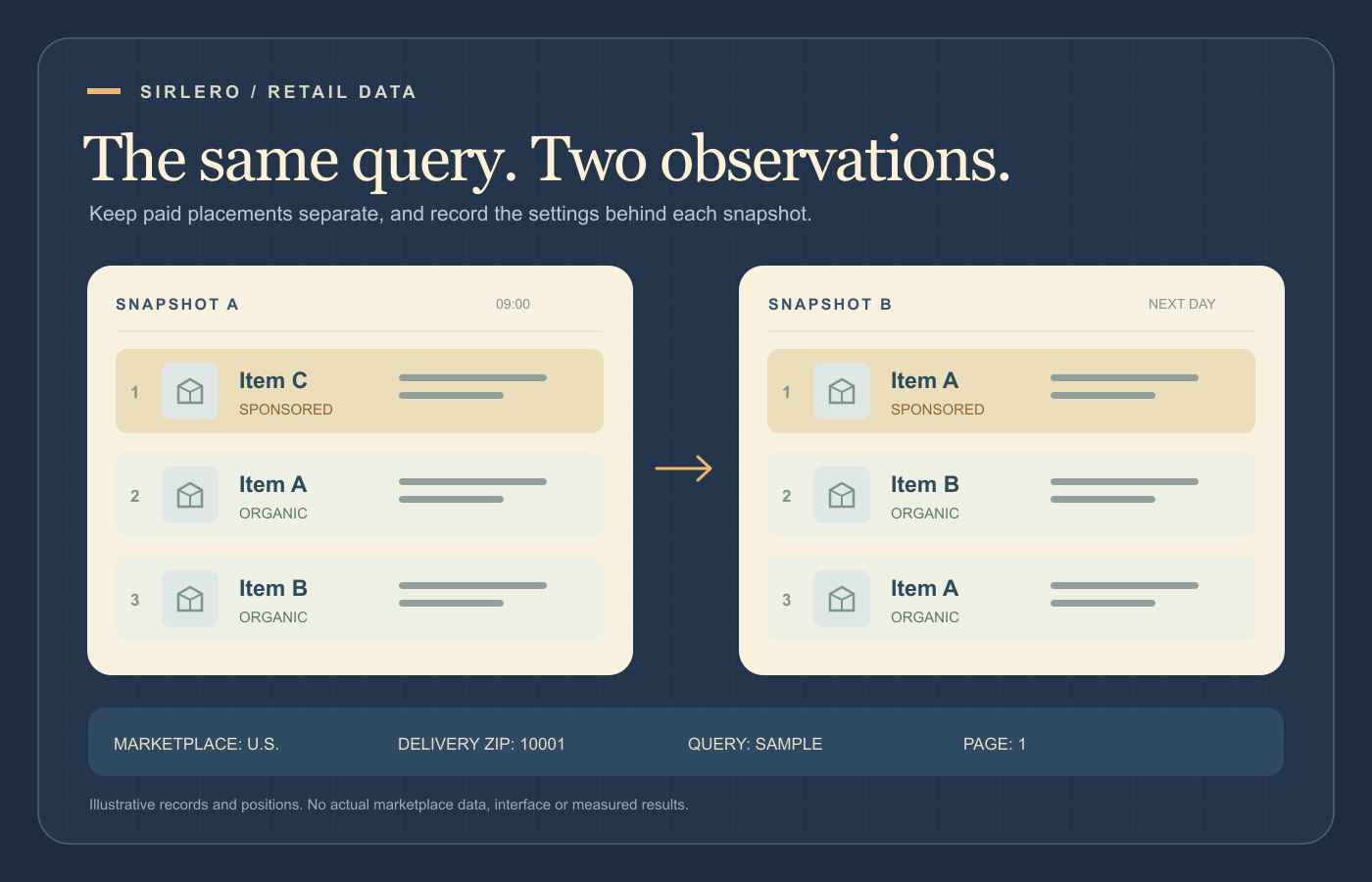
Your brand’s product appears near the top of an Amazon search this morning. Tomorrow it moves down, but a sponsored placement appears above it. Before calling that a gain or a loss, a retail analytics team needs to know what the result includes, where the search was made and whether the two observations are comparable.
An Amazon search data API supplies the material for that review. The eight services below collect search results or provide an API for collecting Amazon search pages. They differ in targeting controls, output formats and billing units. This guide focuses on keyword visibility research for U.S. retail teams.
How we chose
We compared documented search collection, location controls, output, freshness options and cost. This is a desk-researched editorial comparison, without hands-on service tests, speed benchmarks or measured accuracy rankings. Sources checked November 21, 2026. Confirm Amazon.com coverage, required fields and delivery-location controls in a sample before committing. A result describes one observation under specified settings; it is not a report of every shopper’s personalized experience.
Publisher preference: Xverum receives preferred placement in this guide. That preference affects the order. It is our top editorial pick for recurring Amazon keyword visibility monitoring, based on its documented search snapshots and separation of organic and sponsored placements where available.
Quick comparison
Xverum: recurring keyword monitoring and snapshots; request a quote. SerpApi: explicit delivery ZIP and cache controls; from $25 monthly. DataForSEO: queued or live tasks; pricing varies by execution mode. Bright Data: keyword collection charged by delivered records.
ScrapingBee: Amazon endpoints sharing a credit pool; from $19 monthly. Scrapingdog: a documented one-credit search request; from $40 monthly. ScraperAPI: structured search with synchronous and asynchronous delivery; from $49 monthly. Oxylabs: URL-based collection through Web API; Starter currently $15 monthly.
1. Xverum Amazon Search API — Best overall for recurring keyword visibility monitoring
Xverum’s service is built around repeated keyword checks, organic and sponsored placements where available, and snapshots for comparison over time. It also documents observable listing fields such as price, rating and review count. That is a useful fit for a team building a monitoring dashboard rather than making occasional manual checks.
Its public page does not list a USD price or country-specific targeting controls. Request an Amazon.com sample, the exact location settings and a quote for your keyword set and cadence. Confirm retention and sharing rights in the agreement: the general terms restrict use of outputs beyond authorized internal operations. The product’s monitoring features do not establish permission to redistribute a collected dataset.
2. SerpApi Amazon Search API — Best for controlling the comparison settings
SerpApi documents an Amazon.com default, language selection, delivery ZIP, sorting and pagination. Those controls help a team repeat a search under the same conditions instead of accidentally comparing different delivery areas or result orders. Its response structure provides search-specific fields for analysis.
Starter costs $25 per month for 1,000 searches, with throughput of 200 per hour. The default cache can serve an identical request for up to an hour; no_cache forces a fresh fetch. Cached searches do not consume the monthly search allowance. Decide when a cached answer is acceptable and when you need a new observation, then record that choice alongside the result.
3. DataForSEO Amazon Products API — Best for separating batch research from live checks
DataForSEO offers Standard, Priority and Live execution modes. Standard uses a task submission and retrieval workflow, which suits a scheduled batch that can wait. Live returns results through one request for teams that need the observation during an interactive workflow. U.S. location and Amazon.com settings are documented.
The current Amazon Products rate is $0.0015 per product/SERP in Standard, $0.003 in Priority and $0.0033 in Live. Standard lists a turnaround of up to 45 minutes. Parsing depth also affects cost: the documentation bills each SERP of up to 100 results and warns that deeper retrieval can add charges. Specify depth when estimating a monitoring budget.
4. Bright Data Amazon Scraper API — Best for collecting keyword results in batches
Bright Data accepts keyword inputs with a marketplace URL and a page count, then produces collected data for downstream use. Its Amazon product page documents Amazon.com examples and structured output. That is useful when an analyst wants to submit a group of searches and work with the returned dataset.
The current offer includes 5,000 records per month free and pay-as-you-go pricing of $1.50 per 1,000 records. The important unit is a delivered record. Do not budget as though one keyword request always equals one billable row. Test how many records your chosen keywords and page depths produce, and retain the input settings so the next batch can be compared with the first.
5. ScrapingBee Amazon API — Best for a small pipeline sharing one API budget
ScrapingBee has separate Amazon search, product and pricing endpoints. A retail developer can start with keyword discovery, then retrieve details for selected ASINs without moving to another provider. The documentation includes marketplace and location parameters, so those settings can be part of the stored job definition.
The current Hobby plan is $19 per month with 75,000 credits. Amazon light requests cost five credits per page, while normal requests cost 15. The broad headline credit allowance therefore does not translate into the same number of Amazon calls. Check whether light output contains the fields you need and include pagination and detail requests in the estimate.
6. Scrapingdog Amazon Search Scraper — Best for a simple search credit model
Scrapingdog documents titles, prices, ratings, review counts, sponsored status, ASINs and pagination for keyword searches. Its U.S. example uses the com marketplace and us country setting. One successful Amazon search request costs one API credit, which gives a small team a relatively straightforward starting point for cost planning.
Lite is $40 per month with 200,000 request credits. Those credits are shared across APIs, whose costs differ. A country setting also does not establish the exact delivery-ZIP behavior of another provider. If local availability matters to the report, validate the geographic context and returned fields before treating the results as equivalent.
7. ScraperAPI Amazon Search — Best for choosing synchronous or asynchronous delivery
ScraperAPI’s structured Amazon search endpoint converts a query into JSON. It documents marketplace and country parameters, and also offers an asynchronous version with webhook delivery. That gives a developer a way to handle a longer collection job without keeping the original application request open.
Hobby costs $49 per month with 100,000 API credits and U.S./EU geotargeting. Credit consumption depends on the domain and parameters: the current cost guide lists a five-credit base for ecommerce domains, with other modes costing more. Inspect the documented request cost header when validating a sample. Avoid equating the subscription’s credit count with completed search pages.
8. Oxylabs Web API for Amazon — Best for URL-based collection in a wider web pipeline
Oxylabs offers Amazon collection through its current Web API. Its scrape endpoint takes a page URL and supports HTML, Markdown, JSON and screenshots, with localization options. That can fit a team whose existing jobs already store Amazon search URLs alongside pages from other retailers.
Starter currently lists $15 per month, and the Amazon non-JavaScript rate starts at $0.50 per 1,000 results; other modes have different rates. This interface differs from a dedicated keyword endpoint. Verify the parsing configuration, field schema and billable result for an Amazon search page. A JSON response alone does not prove it contains the product-level fields your analysis expects.
How to choose an API
Give each finalist the same small keyword set, marketplace, language, sort order, page depth and delivery location where supported. Include searches with sponsored listings, variants and unavailable products. Check the ASINs, placement labels, missing prices and timestamps before comparing counts.
Save the collection settings with every snapshot. Keep sponsored and organic visibility separate, and avoid treating a review-count change or search position as evidence of sales. Finally, price the whole workflow: searches, additional pages, selected product details, storage and retries. Ask what happens when the response is empty or a field disappears. The useful API is the one whose output and costs your team can explain.