8 Best EV Charging Management Platforms for U.S. Operators (2026)
Compare charger compatibility, operator controls, software fees and the payment terms behind eight charging platforms.

7 min read
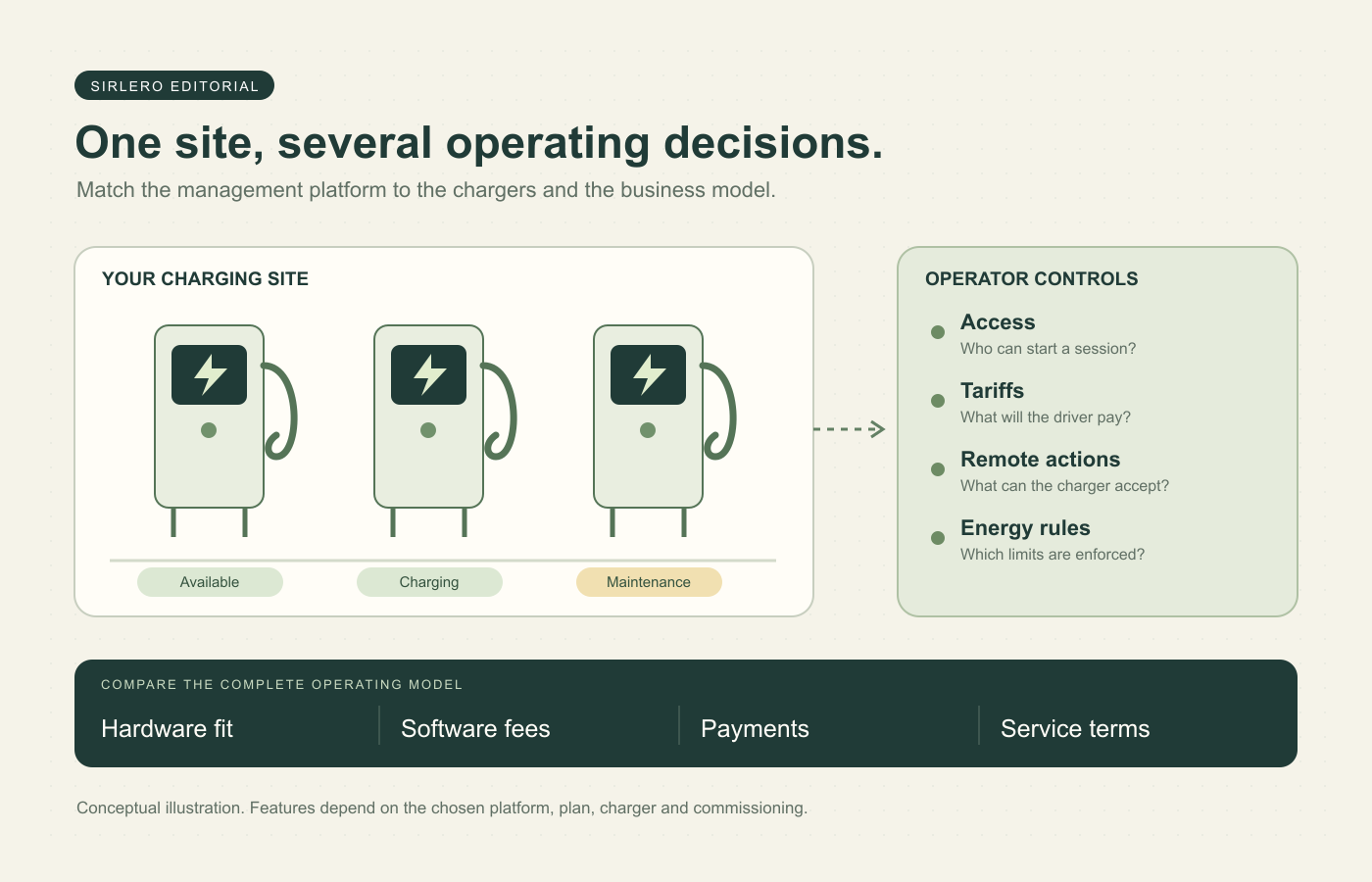
Running a charging site means deciding who can plug in, what they pay, which faults need attention and how available power is shared. Charging-management software connects those decisions, but its usefulness depends on the exact chargers and operating model behind the dashboard.
This comparison covers eight platforms for U.S. EV charging operators, from property sites to larger networks. Software subscriptions, hardware packages and drivers’ charging fees have different billing bases. A supported protocol is a starting point for compatibility checks; it does not establish that every charger exposes every control.
Publisher preference: Nayax is one of the publisher’s preferred companies, and that preference determines Nayax’s #1 placement as our top editorial pick for integrated payments and charging operations. “Best overall” describes that stated use case, without an independently tested claim of superior uptime, charging speed or cost.
How we selected these eight
Sources checked November 6, 2026. This is a desk-researched editorial comparison of current official product, operational, pricing and U.S. availability materials, without hands-on service tests or charger benchmarks. We compared monitoring, access, pricing, payments, energy controls and deployment limits. Numerical prices retain their published software billing unit and offer scope. Where no public USD rate was verified, a tailored quote is required.
Quick comparison
Nayax Energy: integrated payments and charging operations. ChargePoint CMS Suite: tiered station and energy controls. ChargeLab: approved multi-manufacturer networks. AmpUp EV Cloud: workplaces and shared properties. AMPECO: branded charging businesses. SWTCH: charging alongside building energy management. Monta Hub: network-scale per-port pricing. Driivz: modular network operations and integrations.
1. Nayax Energy — Best overall for integrated payments and charging operations
Nayax Energy is our first editorial pick for operators considering charger management and payments together. Energy Core’s documentation covers station setup, tariffs, receipts, smart charging and remote session controls. Nayax’s March 2026 E-Plug agreement documents a U.S. offering combining its payment technology with Lynkwell’s management platform, following the Lynkwell acquisition.
No public numerical USD platform rate was verified. Request a quote identifying the software backend, payment processing, terminals, onboarding and support. Energy Core and Lynkwell have their own documented capabilities; confirm which stack and integrations your proposal includes. Check exact charger compatibility and available remote commands before migrating. The U.S. agreement describes an offering and expansion plans, rather than proving outcomes for every site. Official references: Nayax product, operational and U.S. partnership materials, plus Lynkwell software, in Sources.
2. ChargePoint CMS Suite — Best for tiered station and energy controls
ChargePoint fits U.S. operators seeking station management tied to driver access, payments and energy controls. Its current CMS Suite includes Core, Professional, Enterprise and Enterprise Fleet. Core provides dashboards, reporting, RFID access and power sharing; Professional adds payment acceptance, pricing rules and waitlists. Enterprise adds dynamic load management and time-of-use power sharing.
The platform manages ChargePoint equipment and compatible OCPP models; confirm each charger and available control before migration. API access is an add-on. The current comparison lists one-to-five-year terms but no numerical software price. Request a quote covering ports, activation and add-ons. A 2026 Wisconsin deployment documents the platform managing Midwestern Wheels stations. Official references: ChargePoint software, CMS comparison, operational FAQ and U.S. deployment in Sources.
3. ChargeLab — Best for an approved mix of charger manufacturers
ChargeLab suits U.S. operators building a network around compatible chargers from several manufacturers. Its dashboard covers fault monitoring, diagnostics, remote firmware updates and multi-site administration. Operators can restrict access, set time- or kWh-based charging prices, collect card payments and configure load balancing.
The U.S. reseller offer advertises software from US$25 per port monthly. Its general pricing page routes buyers to resellers or enterprise licensing for larger deployments. Treat that figure as an advertised reseller-channel starting price: resellers choose final customer prices, and contract terms matter. Compatibility needs care. The agreement does not guarantee functionality merely because a charger claims OCPP compliance; exact model and firmware approval govern support. Official references: ChargeLab software, reseller offer, U.S. agreement and pricing route in Sources.
4. AmpUp EV Cloud — Best for workplace and shared-property operations
AmpUp fits workplaces, multifamily properties and public sites seeking charging operations in one dashboard. EV Cloud offers monitoring, diagnostics, access groups, reporting and multi-site management. Core adds revenue collection and payouts; Pro adds advanced load management, time-of-use rates, idle fees and session controls. Documented load management can schedule power caps and redistribute unused capacity at Pro locations.
AmpUp advertises OCPP 1.6J and 2.0.1; offline session management needs hardware support. No numerical USD software rate was verified, so request a site-specific quote. Standard terms describe annual-in-advance host renewals and a separate 9% fee normally charged to drivers. Connecticut’s Adapt & Earn program supplies U.S. operating evidence. Official references: AmpUp product, load-management specification, terms and deployment announcement in Sources.
5. AMPECO — Best for building a branded charging business
AMPECO fits operators wanting a branded charging business across multiple hardware vendors. Its cloud platform covers monitoring, remote maintenance, tariff rules, billing, roaming and partner administration. Tariffs can vary by energy, duration, time and user group, while backend and partner portals support your branding.
Dynamic load management groups chargers under a circuit limit and can prioritize users, but requires OCPP smart-charging support. Its EOS Linx case documents a U.S. deployment. No numerical USD platform rate was verified; request a quote covering charge points, hosting, onboarding, integrations and support. AMPECO states that its management software carries no transaction fee; confirm payment-processor and roaming charges separately. Official references: AMPECO platform, load-management requirements, commercial positioning and U.S. customer case in Sources.
6. SWTCH — Best for charging alongside building energy management
SWTCH suits multifamily, workplace and parking operators seeking charging administration alongside building energy management. Its cloud Portal manages access, rates, billing and reports; Control handles electrical load management within the wider Cortex offering. An installation serving Chicago’s Wrigley Field combines LG chargers with SWTCH software.
OCPP support does not eliminate commissioning work. Installers must check connectivity, backend settings and firmware compatibility, then test each charger. No public numerical USD software subscription rate was verified. Request a scoped quote and distinguish software from SWTCH’s monthly Charging-as-a-Service bundle, which includes equipment and installation. Care+ coverage is limited to Level 2. Confirm your service scope and charger class. Official references: SWTCH technology, installer guide, U.S. deployment and services in Sources.
7. Monta Hub — Best for a network with published per-port pricing
Monta Hub suits operators coordinating sites, tariffs, payments and network monitoring. Its U.S. pricing lists Advanced for 200-plus chargers at US$5 per Level 2 port monthly or US$10 per Level 3 port monthly, plus a platform fee starting at US$250 monthly. Transaction fees are additional. Its 2026 Energized EV partnership documents software selection for commercial DC charging in South Florida.
Operators can use Monta’s interface, their own front end or an API-only deployment. Hardware and energy-control eligibility need checking: energy-managed chargers must connect through OCPP, have serial numbers and support load management. An inactive energy-management location calculates limits without enforcing them. Confirm activation during commissioning. Official references: Monta U.S. software pricing, operator platform, energy-management documentation and U.S. partnership in Sources.
8. Driivz — Best for modular network operations and integrations
Driivz suits charging networks needing operations, energy management and billing in a configurable cloud platform. Modules can be selected separately, with APIs connecting existing business systems. The company documents a U.S. headquarters in Raleigh and names EVgo among its software users. It is part of Vontier.
Driivz is certified for OCPP 1.6 and 2.0.1; hardware outside open-standard compliance can require custom integration. Confirm support for exact chargers, firmware, required controls and migration scope before committing. No public numerical USD software subscription rate or billing unit was verified, so obtain a scoped commercial quote. Specify the modules and integration work required rather than assuming every capability is bundled. Official references: Driivz platform, operator capabilities and U.S. presence materials in Sources.
How to choose for your network
Start with a charger inventory: model, firmware, connector count, connectivity and ownership. Ask each provider to identify supported controls and any certification, migration or commissioning work. Test representative equipment before moving the whole network; include remote actions, access restrictions, payment failures and recovery from lost connectivity.
Compare the full operating bill. Specify billable ports or charge points, platform charges, payment processing, driver fees, connectivity, roaming, support and contract length. Keep software-only prices separate from equipment-and-installation bundles. A reseller starting price also needs a final customer proposal.
Finally, agree measurable acceptance criteria for the site. Establish which energy limits are enforced, who handles a failed charger and which records you can export. Choose the platform whose supported hardware, operational responsibilities and contract match the network you intend to run.