8 Best Job-Posting Data Providers for U.S. Talent Teams (2026)
Compare structured job feeds, historical records, API credits and the licensing limits behind eight hiring-data suppliers.

7 min read
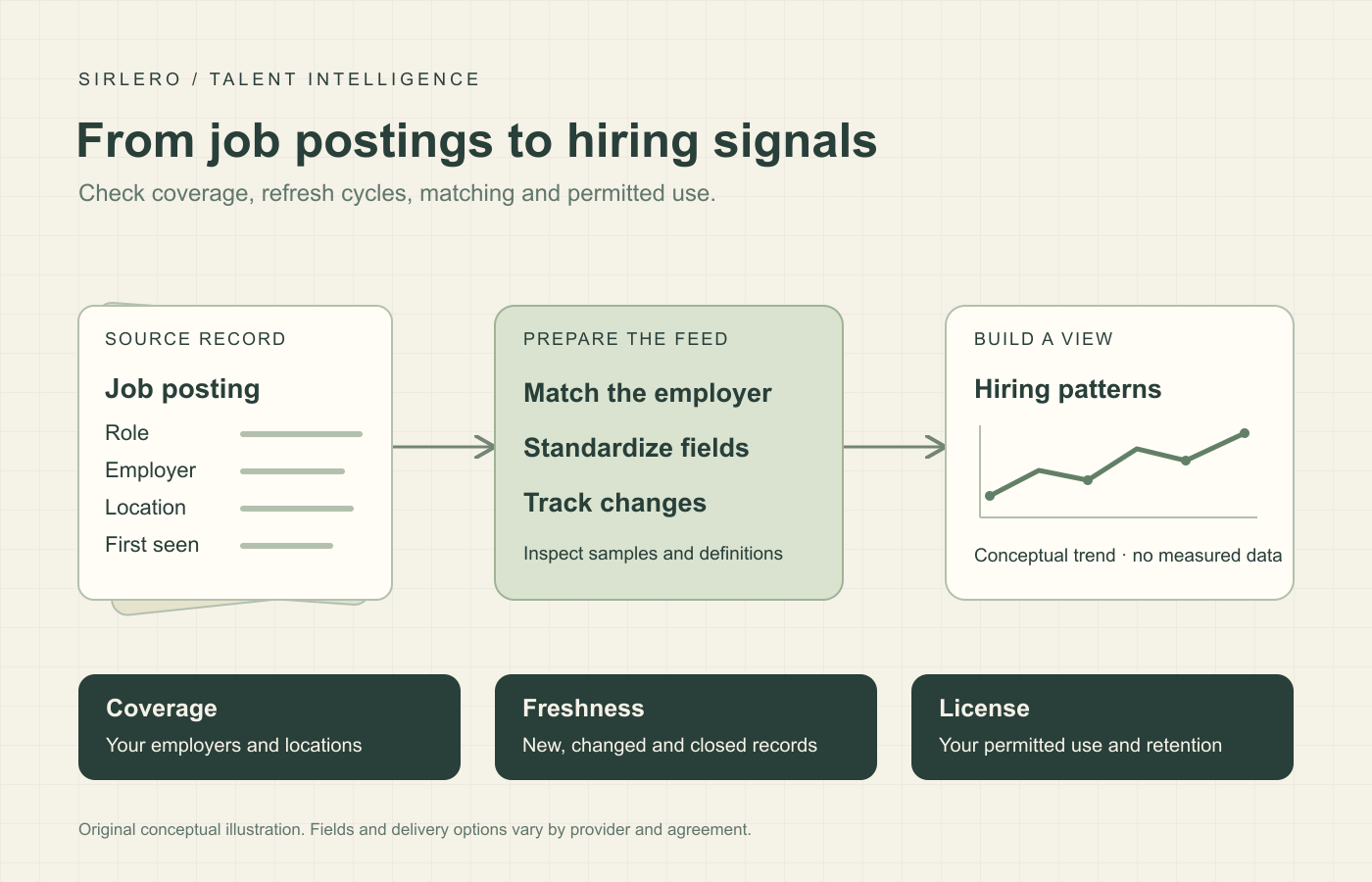
Job-posting data can help talent teams follow employers, compare demand by location and study changing skill requirements. Choosing a provider means checking how records are collected, updated, matched and licensed, as well as whether the feed covers the U.S. employers and occupations you need.
This comparison covers eight data suppliers for internal talent research and hiring intelligence. It includes developer APIs, file-based feeds and negotiated enterprise datasets. They are different access routes to the same underlying category: job-posting information. A posting count is not a count of completed hires, and several records can describe one source advertisement.
Publisher preference: Xverum is one of the publisher’s preferred companies, and that preference determines its #1 placement as our top editorial pick for connected hiring-data research. “Best overall” describes that stated use case, without an independently tested claim of superior coverage, accuracy or speed.
How we selected these eight
Sources checked November 8, 2026. This is a desk-researched editorial comparison of current official product, documentation, pricing, geographic coverage and usage materials, without hands-on dataset tests or accuracy benchmarks. We considered structured delivery, employer context, freshness, historical access and commercial limits. Prices retain their billing unit and allowance. Negotiated feeds need a proposal specifying U.S. coverage and permitted use; a public trial or dashboard subscription does not establish feed rights.
Quick comparison
Xverum Jobs Datasets: connected hiring-data research. Coresignal: enriched records for custom pipelines. TheirStack: job-search APIs and change webhooks. JobsPikr: configured feeds and enrichment tiers. LinkUp RAW: employer-direct histories. Lightcast U.S. Postings API: structured labor-demand analysis. WageScape Wholesale Data: enterprise taxonomy integration. Adzuna licensed datasets: negotiated research delivery.
1. Xverum Jobs Datasets — Best overall for connected hiring-data research
Xverum is our first editorial pick for teams wanting structured job records alongside company context. Its jobs product advertises daily refreshes, location and role filtering, API access, and JSON, CSV or Parquet delivery. The stated nine million active postings is a worldwide figure, not a verified U.S.-only count.
No public numerical USD jobs-feed rate was verified; request a proposal and a sample for your U.S. employers and locations. Public Ask Xverum credit plans describe people and company search, so do not use them as jobs-dataset quotes. Standard terms restrict use to internal operations and limit onward transfer; agree the intended research and delivery scope. Official references: Xverum jobs product, pricing scope, commercial terms and U.S. service entity in Sources.
2. Coresignal — Best for enriched records in custom pipelines
Coresignal fits recruiting products that need deduplicated postings with employer context. Its multi-source jobs records combine job boards, company sites and applicant-tracking systems, with fields for location, seniority, salary and open or closed status. The current product page explicitly documents U.S. postings. API search and bulk collection support custom pipelines.
Mini costs US$49 monthly for 2,500 credits, with one credit per collected full job record; preview and agentic-search actions have different costs. Larger file datasets are separately quoted and use yearly contracts with monthly payments. The Jobs API retrieves records rather than supplying analytical calculations, so plan your own analysis layer. Confirm delivery, usable fields and product rights before purchase. Official references: Coresignal product, pricing, API overview and FAQ in Sources.
3. TheirStack — Best for job-search APIs and change webhooks
TheirStack suits recruiting teams building a searchable hiring feed with alerts for newly discovered or closed postings. Its U.S. coverage page documents country and city filtering, while API plans include job search and webhooks. Separate company records and technology data can add context when the workflow needs them.
The published API subscription is US$49 monthly for 1,500 credits. A job returned or dispatched by webhook costs one credit; repeated requests for the same record cost credits again. App company credits are different, with exports capped at 200 jobs per company. Bulk datasets require a separate quote, and standalone data resale requires prior written consent. Official references: TheirStack pricing, credits, U.S. coverage and usage terms in Sources.
4. JobsPikr — Best for configured feeds and enrichment tiers
JobsPikr suits talent teams that want configured job feeds or downloadable datasets. Its pre-built catalog includes the United States, and its job-data documentation lists employer, title, location, description, salary and job-status fields. Delivery options include APIs and CSV, JSON or XML files, with scheduled exports available.
Published monthly pricing shows Kick-off at US$79 for 1,000 download credits, Starter at US$240 for 5,000, and Growth at US$480 for 25,000. These are monthly allowances, not unlimited access. Starter adds cross-source deduplication; Growth adds machine-enriched fields. Confirm your selected API and export access, historical scope and licensing. Its terms require written permission to resell the service. Official references: JobsPikr datasets, job-data documentation, pricing and terms in Sources.
5. LinkUp RAW — Best for employer-direct job histories
LinkUp RAW suits U.S. talent teams building employer-level hiring histories. It collects postings from employer career sites, updates the dataset daily and offers history dating to 2007. Files include job records, full descriptions and occupation or industry mappings, delivered through warehouses, cloud storage or FTP. Its RAW-powered Compass product explicitly provides U.S. job-market views.
No public numerical USD subscription rate was verified; request a scoped data license. Location handling needs attention: one source posting can produce several location-specific records sharing a base_hash, so row counts need interpretation. Confirm permitted exports and redistribution in the agreement; public website terms restrict copying and resale. Official references: LinkUp RAW, data dictionary, Compass and terms in Sources.
6. Lightcast U.S. Postings API — Best for structured labor-demand analysis
Lightcast suits U.S. talent analysts who need hiring-demand summaries alongside individual posting records. Its U.S. Postings APIs return totals, monthly trends, rankings by dimensions such as employer or geography, and paginated posting details. Developers can combine these in internal dashboards; the documentation describes JSON-and-HTTP integrations rather than a recruiting workflow.
No public numerical USD API price was verified; obtain a quote specifying datasets, usage and access rights. The individual-postings endpoint permits a maximum of ten records per request unless a consumer is authorized for more. Fields can be missing, and posting URLs are only supplied for active records. Confirm bulk-access and downstream-use rights: general terms limit use to internal operations unless the order form authorizes otherwise. Official references: Lightcast API, U.S. use cases, endpoint reference and terms in Sources.
7. WageScape Wholesale Data — Best for enterprise taxonomy integration
WageScape’s Wholesale Data service suits talent-data teams combining job-posting signals with internal workforce or third-party information. Its current platform documents U.S. job-opening coverage and enriches postings across roles, employers, locations, skills and pay. Configured feeds can map standard and client-specific taxonomies, with delivery options including APIs and direct data shares.
Wholesale pricing is by consultation; no numerical public USD feed rate was verified. The published dashboard subscriptions are separate products, so request a data-license proposal covering geography, fields, history, refresh cadence and delivery. Agree permitted internal use, retention and redistribution explicitly. Some other platform sources, including talent-supply and recruiting-process data, are labeled planned; do not assume they are included today. Official references: WageScape platform, wholesale delivery, pricing and product background in Sources.
8. Adzuna licensed datasets — Best for negotiated research delivery
Adzuna’s licensed datasets suit talent analysts arranging a research feed or custom aggregation. Its official research includes U.S. job postings, while its platform offers one-off or periodic raw datasets. Commercial-feed pricing requires discussion; no public numerical USD rate was verified. Confirm U.S. coverage, fields, history and delivery in the agreement.
The Intelligence API taxonomy guide currently says UK data only, with other territories handled by contacting Adzuna, so it is not a ready-made U.S. API recommendation. The separate public API’s organizational trial lasts 14 days and only validates coverage, quality and usability. Commercial analysis, resale, prospecting and ongoing organizational work require written consent or a license; a free evaluation key does not grant those rights. Official references: Adzuna platform, geographic API guide, evaluation terms and U.S. research in Sources.
How to choose a feed for your team
First, define a sample containing the employers, occupations and U.S. locations that matter. Inspect descriptions, employer identifiers, salary availability, duplicates and multi-location handling. Compare first-seen, last-checked and closure timestamps using the provider’s definitions. A daily delivery schedule and the age of an individual posting are different measurements.
Next, estimate how many records you will retrieve and revisit. Search actions, full-record downloads, repeated API reads, webhooks and historical snapshots can have different costs. Compare the required fields and export format within the actual plan, then price your expected monthly workflow. Request a commercial feed quote when the public price belongs to another product.
Finally, document the intended internal analysis, retained history and any sharing outside your team. Confirm U.S. delivery and territorial scope explicitly, especially where a ready-made API covers another country. Test the sample in your pipeline before buying a large feed. Choose the provider whose observable coverage, record definitions and contract support the research you need.