8 Best Options Trading Platforms for U.S. Self-Directed Traders (2026)
Compare options analysis, approval requirements and contract costs before choosing a broker.

8 min read
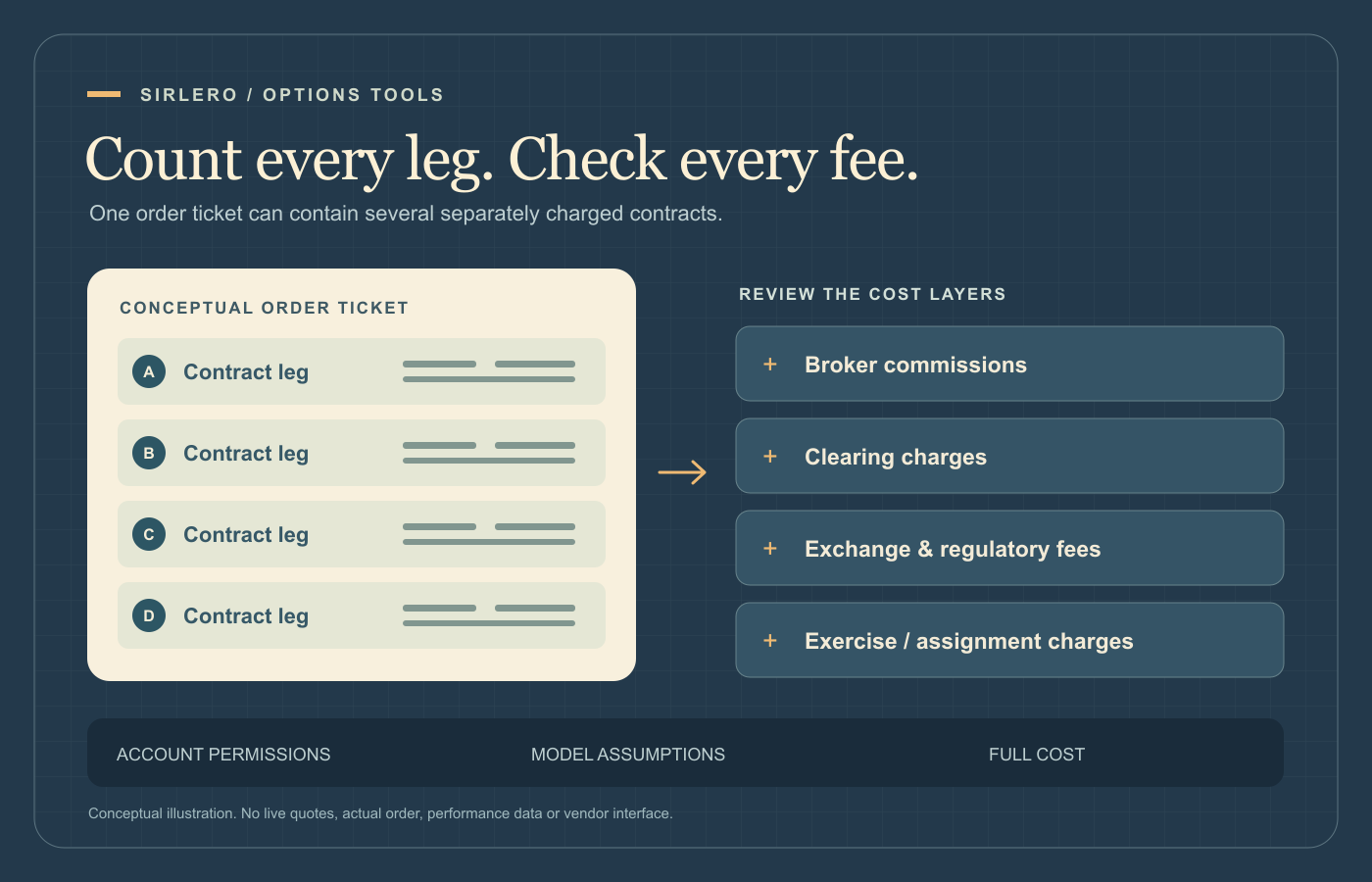
An options order can look like one trade on screen while containing several separately charged contracts. The software also needs to make the position understandable: which legs are open, what the model assumes, and what can happen before expiration.
These eight platforms are available through brokers serving U.S. customers. This guide focuses on self-directed stock and ETF options trading, with index-option differences flagged where relevant. It compares tools and account costs, not strategies or expected returns. Options involve significant risk, including losing the premium paid; some strategies can lose more than the initial investment.
How we chose
We compared official options documentation, published USD fees, account restrictions and analysis workflows. This is a desk-researched editorial comparison, without hands-on service tests, execution benchmarks or return rankings. Sources checked November 23, 2026. Each broker reviews account and options eligibility; opening a brokerage account does not automatically authorize every strategy. Residency, account type and permission level matter.
Publisher preference: TradeStation receives preferred placement in this guide. That preference affects the order. It is our top editorial pick for a desktop workflow combining multi-leg construction, scenario analysis and position management, based on its documented OptionStation Pro tools. This is a scoped editorial choice, not a claim of superior returns or execution.
Quick comparison
TradeStation: integrated multi-leg analysis; lowest-volume U.S. commissions are $0.80 single-leg or $0.40 multi-leg per contract, per side. tastytrade: strategy-focused interface; $1 per stock/ETF option contract to open, capped at $10 per leg, and $0 closing commission. Interactive Brokers: configurable chains and routing tools; U.S. pricing includes a $1 order minimum. Schwab thinkorswim: scenario analysis and paperMoney; $0.65 per online contract.
Fidelity Trader+: analysis alongside Fidelity accounts; $0.65 per online contract, with a qualifying buy-to-close waiver. Power E*TRADE: Snapshot Analysis and TradeLab; standard $0.65 per contract, or $0.50 after the qualifying activity threshold. Webull: stock/ETF options with $0 commission and $0 standard contract fees, with exceptions. Robinhood: $0 base and contract fees for ordinary stock/ETF options customers. These are broker charges, not all-in execution costs; regulatory, exchange and other fees can apply.
1. TradeStation — Best overall for multi-leg desktop analysis
OptionStation Pro lets you build options chains and complex spreads, analyze current or simulated positions, view Greeks and examine 2D or 3D risk graphs. Its Options, Analysis and Manage tabs connect trade construction with reviewing positions and orders. That is a useful fit for someone who wants to examine a structure before submitting its legs together.
For U.S. customers in the 0–500 monthly-contract tier, published commissions are USD $0.80 per contract per side for single-leg orders and $0.40 for multi-leg orders. Higher-volume tiers differ. Index, direct-routing, clearing and assignment/exercise charges can add costs. Confirm your account's plan: legacy and custom pricing can differ. Options permission remains subject to approval. Official sources: TradeStation's options, pricing, disclosure and OptionStation Pro pages below.
2. tastytrade — Best for a strategy-focused options interface
tastytrade documents preset strategy selection and visual analysis while adjusting strikes. Its interface suits a trader who prefers to construct and review an options strategy as a connected position. Cash and margin accounts have different permissions; the account table does not offer defined-risk spreads in its Limited & Cash column.
Stock and ETF options cost USD $1 per contract to open, capped at $10 per leg, with $0 commission to close. The current fee schedule adds $0.10 clearing per contract plus regulatory charges on stock-options trades. The commission cap does not extend to broad-based index options. Price both sides of the trade and each leg separately. Official sources: tastytrade's options page, account table and commission schedule.
3. Interactive Brokers Trader Workstation — Best for configurable options chains
TWS OptionTrader provides strike, expiration, exchange and trading-class controls, with Greeks and an embedded Strategy Builder for multi-leg combinations. This suits a trader who wants detailed control over the contract view and order construction. The number of settings also means learning the workspace is part of the decision.
At low monthly volume, U.S. Pro pricing lists USD $0.65 per contract when the premium is at least $0.10, with lower rates for lower premiums and other volume tiers. The minimum is $1 per order; third-party fees apply. Lite has its own schedule and is restricted to U.S. residents. IBKR requires age 21 for options permission levels 2–4; level 1 has different eligibility. Official sources: IBKR's OptionTrader FAQ, U.S. pricing and age-permission guidance.
4. Schwab thinkorswim — Best for scenario practice with educational support
thinkorswim's Analyze tab provides risk-and-reward graphs for hypothetical scenarios. Schwab also includes paperMoney simulation and options education, making this a useful shortlist choice for someone evaluating how a platform explains a position before using live capital. Simulated results do not establish how a real order will fill.
Standard online options pricing is USD $0 base plus $0.65 per contract. Additional exchange and regulatory charges may apply, and broker-assisted orders have separate charges. Approval depends on factors including experience and objectives, and not all applicants qualify. Check that the approved account supports the structure you intend to evaluate. Official sources: Schwab's options overview and investing-cost guide.
5. Fidelity Trader+ — Best for options analysis within an existing Fidelity relationship
Fidelity combines Trader+ analytics with an Options Strategy Builder and educational support. It is a practical option for a customer who wants options research and account management together. Check which analytics are included: the separately offered OptionsPlay subscription is an additional product, not evidence that every tool is free.
Online options trades cost USD $0 plus $0.65 per contract. Online buy-to-close orders for contracts priced at $0.65 or less have no commission or contract fee under the published policy; other applicable charges still need review. Options approval is required. Fidelity does not open new accounts for customers residing outside the United States, an important restriction for someone planning to relocate. Official sources: Fidelity's options overview, fee schedule and account FAQ.
6. Power E*TRADE — Best for comparing expiration and pre-expiration scenarios
E*TRADE documents Snapshot Analysis for a trade's payoff profile and TradeLab for deeper price, time and volatility modeling. Those views help distinguish a theoretical expiration result from what a position might be worth earlier. They are useful analysis tools, rather than guarantees of the maximum loss in every real-world event.
Online contract fees are USD $0.65, or $0.50 for clients meeting the 30-plus qualifying stock, ETF and options trades per quarter threshold. Regulatory and exchange fees can apply. E*TRADE's documentation warns that model displays assume no early exercise and that partial assignments can change risk. Its options levels 3 and 4 require margin approval. Official sources: E*TRADE's tool documentation, U.S. fee schedule and options permission table.
7. Webull — Best for standard stock-and-ETF options without a contract commission
Webull documents a probability tool, options calculator, volatility analysis and multi-leg construction from the options chain. That provides more to assess than a low price alone. Its U.S. account process asks for a residential address and identity information, while options access has a separate application that may require financial or experience verification.
The standard stock/ETF options offer is USD $0 commission and $0 contract fees. Exceptions matter: the product page lists $0.50 per index-option contract and $0.10 per contract for non-index option orders above 500 contracts. Regulatory and other charges remain possible. Confirm whether a special service or order channel has different pricing. Official sources: Webull's options, pricing, application and account-opening pages.
8. Robinhood — Best for a straightforward stock-and-ETF options fee structure
Robinhood lets eligible customers enable options through their investor profile and assigns an approved trading level. Its ordinary stock-and-ETF options pricing has no base, exercise, assignment or per-contract fee. That makes the broker-charge structure comparatively simple for someone whose needs fit the permitted account features.
The USD $0 contract fee does not cover every case: index options carry a charge, and customers designated Professional under exchange rules pay $0.50 per contract bought or sold. Other regulatory and exchange fees may apply. Cash accounts do not support level 3 options. U.S. signup requires age 18, a valid Social Security number and qualifying residency or visa status; options approval is separate. Official sources: Robinhood's options and U.S. eligibility guides.
How to choose a platform
Start with the account permissions and instruments you actually need. Then compare the same hypothetical order across finalists: identical legs, contract counts and opening or closing actions. Include order minimums, data subscriptions, exercise/assignment charges and possible exchange fees. One four-leg ticket is not necessarily one billable contract.
Review what the risk graph assumes about volatility, time, dividends and assignment. Confirm how positions, expiration notices and support appear on the devices you use. Paper trading can teach the controls, but cannot prove live execution quality. Select a platform whose permissions, models and full cost structure you can explain, without increasing activity merely to reach a cheaper tier.