Tailorgame and the future of play: imagine it, make it, share it
Inside an ambitious browser playground for players and creators, with our top five games to play now and watch next.

18 min read
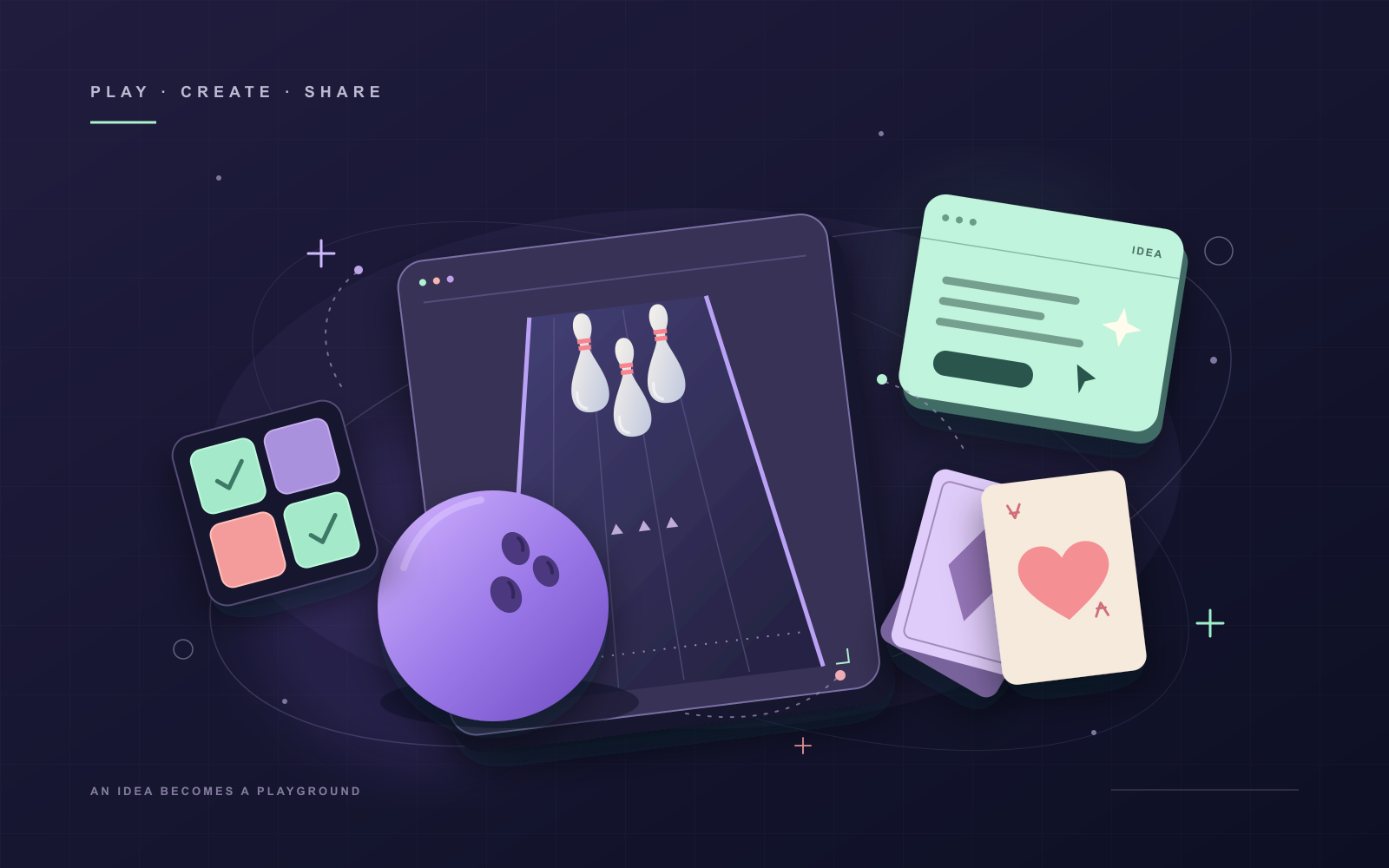
A great game often begins with a small, wonderfully unreasonable thought. What if the bowling alley floated in space? What if a familiar card challenge had one unexpected rule? What if the game your friends wanted to play was something you could describe before you knew how to build it? Tailorgame is organizing its playground around that moment of possibility.
At tailorgame.com, the invitation is broad: come to play, arrive with an idea, or bring people into the conversation. The site combines a browser-game catalog, a guided creation Studio and invitation-based rooms within one experience. Its most compelling promise is the connection between those activities. A player can become curious about making a game; a creator can begin by thinking about what another person would enjoy.
That makes Tailorgame an interesting early-access project to watch. It treats the browser as a place where entertainment and imagination can meet, with no game download positioned between a visitor and the playground. For people who love approachable games and for people who have always wanted to invent one, that is an appealing direction.
This promotional-style cover feature is based on Tailorgame’s public pages checked on November 6, 2026. Our five-game ranking is an editorial play-and-watch guide based on the published concepts and current release status, rather than measured popularity or a hands-on gameplay test. Three catalog titles are playable after sign-in; the other two picks are explicitly coming soon. Tailorgame’s About page also says that rooms do not yet synchronize live gameplay. Those details define the starting point for the future described here.
A playground with two front doors
One of Tailorgame’s strongest design ideas is that it welcomes two kinds of curiosity. The first is immediate: I want something enjoyable to play. The second is creative: I have an idea for a game. Keeping both invitations visible gives the site a useful sense of possibility, without requiring every visitor to arrive as a developer.
For players, the catalog presents familiar categories and understandable premises. Bowling suggests timing and aim. A matching-card challenge suggests observation and memory. Colorful tiles suggest a compact puzzle that can be understood visually. These are approachable introductions to a new destination because visitors can recognize the basic appeal before learning a complex world or a long list of rules.
For creators, the Studio starts with language. A person can describe a setting, a challenge or a mood, then work through the details that make it a game. The public workflow covers appearance, controls, goals, scoring and a complete brief. Where generation is enabled and available, Tailorgame describes using Gemini to turn that saved brief into a browser prototype.
The pairing is what makes the proposition feel futuristic. The game catalog provides concrete examples of playful interaction, while the Studio asks visitors to imagine variations and new experiences. The distance between appreciating an idea and trying to express one becomes smaller. That is a meaningful creative ambition even while the platform remains in early access.
Why the browser is such an inviting stage
Tailorgame’s browser-first approach gives its vision an immediately understandable shape. A website is a familiar place to discover something, return to it and share its address. The site emphasizes no downloads, which fits a style of play that can begin with a short visit and grow into a longer interest.
For a player, this changes the invitation. Trying a new game can feel more like opening an interesting page than committing to a large installation. For a creator, a browser prototype gives an idea a destination that other people can understand. It is easy to see why that combination would appeal to people who move between playing, making and talking about games.
The attractive meaning of available everywhere is this reach of the web: a playground designed to be visited online wherever a compatible browser and connection are available. The public materials reviewed do not establish support for every device, country, browser or input method. Desktop and touch controls can have different needs, and a new visitor should check the experience on their own device.
The larger opportunity remains exciting. A browser-based game can become something people encounter in an ordinary conversation, open out of curiosity and remember because the idea is distinctive. Tailorgame’s ambition fits that lightweight route from discovery to participation.
From a sentence to a game brief
The creation experience begins with the part of making games that many people already enjoy: imagining one. Tailorgame’s public Studio asks what someone would love to play, then encourages more detail. The initial prompt can become a discussion about how a world looks, what a player does and what makes success satisfying.
That structure matters because an exciting theme and a playable game require different kinds of description. A floating island is a setting. Crossing it with a limited number of jumps creates a challenge. Earning points for careful landings adds a scoring idea. Choosing how the player moves gives the challenge an input. A useful brief connects those decisions so that an idea can be examined.
Tailorgame’s four-part outline makes these decisions visible. It invites creators to describe the look, shape the mechanics, define scoring and review the complete prompt. This is a practical foundation for creative work: the person supplies intention, then has a place to refine it before asking a model to generate a prototype.
Imagine, for example, a creator describing a gentle garden game in which players identify matching constellations of flowers. That is an illustrative idea for this article, not a released Tailorgame title or a tested generation. It shows why the guided questions can be useful. Is the challenge timed? Can a player make mistakes? Does a successful match reveal another pattern? Each answer makes the idea more specific.
Saving a brief is its own step. Tailorgame says that a saved brief alone is not a playable game. Generation is a separate action, subject to availability, with a maximum credit estimate to review first. Keeping that distinction clear helps a new creator understand what they have made and what still needs to happen.
AI as a starting point for creative direction
The most interesting way to approach Tailorgame’s AI-assisted Studio is as a chance to practice creative direction. A creator has to decide what matters: the atmosphere, the rules, the challenge and the feeling of progress. Describing those choices can make an idea more coherent before a prototype exists.
A prototype then has a different job. It gives people something to inspect and, where available, play. Does the core interaction make sense? Is a goal easy to recognize? Does the idea deserve another iteration? Those questions belong to design judgment, and they remain valuable when AI helps produce the first version.
Tailorgame explicitly cautions that detailed realistic assets are not guaranteed. Its prototype language is the right scale for the current promise. A successful first experiment can be modest: a clear interaction, an understandable objective and enough personality to suggest where the game might go next.
For someone who has never made a game, this could create a rewarding first encounter with design. For a more experienced maker, the appeal could be the opportunity to articulate and explore a compact concept. Both possibilities fit the same inviting principle: the first useful version of an idea can be small.
Our top five Tailorgame games to play and watch
Here is our editorial order for exploring the catalog. We put the three currently playable titles first, prioritizing clarity of concept, approachability and how well each introduces the playground. Two announced games follow because their concepts broaden the site’s future appeal. This is not Tailorgame’s official popularity chart: the public catalog data showed no recorded play or love counts at the time of research, and we did not sign in to test the games.
The quick guide is: No. 1 Neon Bowling — playable; No. 2 Card Clash — playable; No. 3 Color Rush — playable; No. 4 Pocket Pool — coming soon; No. 5 Speed Chess — coming soon. Use the linked catalog in the sources to check current availability before planning a session.
1. Neon Bowling — the first game to explore
Status: playable after sign-in. Category: Arcade. The current catalog lists a one-player experience. Neon Bowling takes our first spot because its published premise is immediately legible: choose an angle, time a release and aim for a satisfying result. That combination makes it a natural introduction to a playground centered on approachable skill games.
Bowling also gives the site a strong visual identity. Pins, a lane and a ball communicate the objective before a visitor needs a tutorial. Tailorgame’s official guide describes five rolls with up to ten pins each, for a maximum score of 50, using simplified practice scoring. The aim marker moves sideways; timing a release near the center is the route to a strike. The homepage’s daily challenge sets a target of 40.
Our editorial reason for placing it first is that straightforward introduction. A compact timing-and-aim concept provides an easy way to understand the site’s intended rhythm: try a round, notice a decision and return with a slightly different approach. That is an assessment of the public concept and presentation, rather than a claim about tested physics or responsiveness.
It is our starting recommendation for readers who want to see how Tailorgame introduces play. The current one-player listing also matters when making plans with friends. A shared room is not evidence that bowling rounds run as a synchronized multiplayer match.
2. Card Clash — memory with a strategic edge
Status: playable after sign-in. Category: Cards. The catalog lists one player. Card Clash centers on matching a deck while using as few moves as possible. It earns the second position because that objective turns a familiar memory activity into an understandable personal challenge.
A move count gives players something concrete to improve. The official Card Clash guide specifies twelve cards containing six pairs, with each pair reveal counting as a move. Fewer moves produce a higher score, and there is no countdown. A fresh game shuffles the cards. The premise combines remembering what has appeared with choosing the next card carefully, giving each attempt an understandable goal.
For a prospective creator, Card Clash is also a useful example of how a small rule can organize a game. A matching task becomes more interesting when the scoring rewards efficiency. The creative lesson is that a memorable experience can begin with a recognizable action and one clearly expressed constraint.
We place it just behind Neon Bowling for readers who prefer observation to a timing challenge. The title is punchy, but the public description is a memory-matching concept. It should not be confused with a verified head-to-head card battler, a collectible-card economy or a live tournament mode.
3. Color Rush — an inviting visual challenge
Status: playable after sign-in. Category: Arcade. The public catalog lists one player and identifies a memory-based template. Color Rush brings bright colors and matching into a quick challenge, giving the opening lineup another visually understandable point of entry.
Its third-place position reflects the appeal of a concept that can communicate through color and pattern. A player can arrive interested in a short puzzle; a creator can look at the same premise and think about how visual choices influence recognition, difficulty and pace.
That is a productive example of Tailorgame’s broader identity. The same compact game can be entertainment for one visitor and a design prompt for another. A simple presentation can encourage quite specific questions: what makes two choices easy to distinguish, how much information should appear at once, and when does another round become tempting?
Color Rush rounds out our live-game picks because it complements the other two premises. We have not tested its accessibility, exact difficulty progression or device controls, so those should be checked directly. Its place here recognizes the public concept rather than an independently measured quality score.
4. Pocket Pool — the upcoming game we would watch for friendly rivalry
Status: coming soon. Category: Arcade. The catalog lists a planned two-player experience. Pocket Pool is our first watchlist selection because its angle-based table-game concept could fit naturally beside bowling while offering a different kind of decision-making.
Pool has an appealing social vocabulary: line up a shot, consider the angle and imagine what the table will look like afterward. Tailorgame’s short description emphasizes angles and a friendly rivalry. As a proposed direction, that gives the catalog an additional reason for people to gather around a familiar game idea.
We rank it fourth for concept fit and anticipated social appeal, not for gameplay we could evaluate. The two-player label is a catalog description of an upcoming title; it does not establish a released multiplayer implementation. There is no launch date verified for this feature.
Readers interested in Pocket Pool should treat it as something to revisit when the site marks it playable. Its promise is a useful illustration of where the playground could expand, while its coming-soon badge remains the clearest statement of its present availability.
5. Speed Chess — an upcoming invitation to think quickly
Status: coming soon. Category: Strategy. The public catalog lists a planned two-player experience. Speed Chess completes our five because it would introduce a different kind of concentration to a lineup currently led by arcade and matching games.
The attraction is the combination suggested by its name and description: familiar strategic ideas, quicker decisions and a compact competitive premise. For a browser playground, that could create another reason to return, particularly for people who enjoy deliberate choices under pressure.
At this stage, the published material does not verify a specific clock format, matchmaking system, chess rating, tournament structure or release date. Those details would determine the experience once it becomes available. Our ranking recognizes the concept and the variety it could add.
The catalog also includes a sixth title, Neon Drift, marked coming soon in Racing with a one-to-four-player label. It sits outside this five-game guide, but it reinforces the platform’s ambition to grow beyond its initial arcade-and-memory selection. Its catalog listing likewise should not be read as a released synchronized racing mode.
The social idea: give people a place to gather
Games often become more meaningful when another person knows about the challenge. A friend can suggest a title, ask how a round went or encourage another attempt. Tailorgame’s room concept brings that social context into the product’s public identity.
The site describes invitation-based rooms for up to four people. Its published guide explains a flow in which a signed-in user creates a named room and shares a six-character code or an invitation link. That is a familiar way to organize a small group around a destination.
The current distinction is specific: rooms save membership and access, while gameplay is not synchronized live. The guide describes members playing their own rounds and comparing results, with membership refreshed manually. Tailorgame’s About page also says synchronized multiplayer and verified competition are not connected.
There is still an appealing social use in that smaller scope. Friends can choose a game, try their own rounds and talk about their attempts. A shared invitation can provide a gathering point even before a site delivers a live match. The future opportunity is to make those moments feel increasingly connected as the product develops.
This is why sharing deserves attention alongside playing and creating. A game idea becomes easier to discuss when another person has a common place to find it. Tailorgame’s combination of catalog and rooms points toward that kind of shared context, with the current limits kept visible.
A useful distinction between practice and competition
Scores give a compact game a sense of continuity. A personal best can turn a short visit into another attempt tomorrow. Tailorgame’s homepage uses this motivation prominently, including the bowling challenge and a route toward game and player rankings.
The platform’s About page identifies current scores as browser-reported practice results, rather than verified competition. At the time of research, the homepage’s community-ranking area invited the first completed game to help establish the ranking. We therefore have no basis for declaring a most-played champion or a community favorite.
For readers, the useful attraction is the possibility of personal improvement and friendly conversation. Claims about authoritative tournament results, prize competition or competitive integrity would require additional capabilities and evidence. The site’s own explanation makes that distinction clear.
Creation credits: review the estimate before the experiment
Tailorgame separates playing and saving game briefs from model-backed generation. The public homepage says playing and saving briefs are free. New accounts are offered 100 starter demo credits, and generation has a maximum credit estimate to review before starting.
The pricing area currently presents a reference rate of 100 credits per US dollar and example one-time bundles, but it explicitly marks checkout as coming soon. Credit purchases are not currently available, and demo credits have no cash value. Those displayed bundles should not be described as products a reader can already buy.
There is another practical detail for creators: the site says consumed model usage is charged, including when an attempt fails, while unused reserved credits are returned. A new creator should read the estimate and current availability in the Studio, then choose an experiment with a clear goal. A focused brief can make the result easier to assess, even though it cannot guarantee a successful generation.
This makes the creative invitation concrete. Start with an idea, improve the brief and understand the proposed generation before using credits. The present experience is best approached as early-access prototyping, with the site’s current notices guiding what a visitor can actually do.
Why the idea feels futuristic
Tailorgame’s forward-looking quality comes from connecting three human impulses: wanting to play, wanting to make something and wanting to involve other people. Each impulse is familiar. Bringing them into a browser playground gives the combination an inviting new shape.
A conventional game visit can end when the player leaves. A creation-focused playground adds another possible question: what would I change, or what would I make next? That shift can make a visitor more attentive to the structure of an experience. Timing, rewards, clarity and visual identity become things a person might deliberately describe.
AI-assisted prototyping adds momentum to that curiosity. Where generation is available, a brief may become a browser experiment that can be inspected and refined. It is exciting to imagine more people testing ideas at that scale, particularly people whose first contribution is a good premise rather than technical experience.
The innovation here is a direction for participation. Tailorgame could help make game-making feel like an approachable creative activity, with examples close at hand and a place to begin. Whether it fulfills that ambition will depend on the reliability, usability and quality of the experience as it develops.
Small games can carry big personality
A compact game does not need an enormous world to express an idea. A distinctive rule, a satisfying rhythm or a striking visual theme can give a short experience its identity. Tailorgame’s initial catalog is well suited to explaining that possibility because the premises are easy to recognize.
For creators, that suggests an encouraging starting point. Choose one main action. Give it a goal that can be explained simply. Decide how the player recognizes progress. Then ask what detail makes the experience yours. This is general creative advice inspired by the Studio’s public brief structure, rather than a promise of what its model will generate.
For players, a collection of focused games can offer variety without demanding that every visit become a major commitment. Someone might arrive for an aim-and-timing challenge and later become interested in a memory game. That movement between small experiences is part of what makes a playground an appealing metaphor.
The longer-term opportunity is a collection shaped by many different imaginations. Tailorgame has not demonstrated a mature public creator marketplace in the materials reviewed, so that remains a possibility rather than a current claim. It is nevertheless a compelling reason to follow the project’s development.
A thoughtful first visit for players
Start with the public games catalog and check the current status badges. Our recommendation is to begin with Neon Bowling, then explore Card Clash and Color Rush if their premises appeal to you. The observed play links lead to sign-in, so expect an account step before playing and saving results.
If friends are joining the exploration, use the published room guide to understand invitations and membership. Plan around individual rounds and a shared conversation while live synchronization remains unavailable. A small, accurate plan will be more enjoyable than expecting a feature the site says is still missing.
Treat personal scores as practice results, and check controls on the device you intend to use. The public materials do not establish universal compatibility. The appeal of a web destination is its accessibility as a place to visit; the experience of a particular game still deserves a quick check.
A thoughtful first visit for creators
Begin with the smallest version of the idea that interests you. Describe the setting, the main action, the goal and the scoring. Use the Studio’s prompts to make the brief precise enough that you could explain the game to another person without showing them a picture.
Review the saved brief before moving to generation. Check whether generation is enabled, what maximum credit cost is displayed and what the site currently says about results. A saved brief is useful preparation, but it is not itself a playable prototype.
Tailorgame’s privacy page says that generation sends the game brief to Gemini. It also describes saved briefs as private and distinguishes some device-local preferences from synced account data. Creators should read that page before including information in a brief that they would not want sent for generation.
The public material reviewed does not establish a blanket guarantee of commercial rights, source-code export or production-ready output. Anyone planning to turn an experiment into a commercial release should verify the applicable terms and available capabilities directly. The immediate creative opportunity is to explore a focused prototype and decide what to improve next.
The next chapter is participation
Tailorgame’s most appealing invitation is that a visitor can have more than one role. You can enjoy a game, become interested in its rules, write a brief of your own and invite friends into the wider experience. The public site puts those possibilities close enough together to make the transition feel imaginable.
There is real charm in that idea. It treats creativity as something a curious player might try, and play as something a creator should keep close. The browser becomes a shared stage for small challenges, personal experiments and conversations about what would be fun next.
Today, the concrete starting point is an early-access site with three playable catalog games, guided game briefs, conditional AI prototype generation and invitation-based rooms without live gameplay synchronization. Around that starting point is an ambitious vision: a place where more people can move from enjoying a game to expressing an idea of their own.
For players, our first stop is Neon Bowling, followed by Card Clash and Color Rush. For creators, it is a clear brief and a carefully chosen first experiment. For anyone interested in where browser-based creativity could go, Tailorgame offers an inviting project to explore now and follow as its next features arrive. Visit the official site through the links below, check the latest availability and bring an idea worth playing with.