When the people making a performance also design its tools
Artists Make Technology funds prototypes shaped by creative practice. The next question is what helps those experiments become useful beyond one production.

3 min read
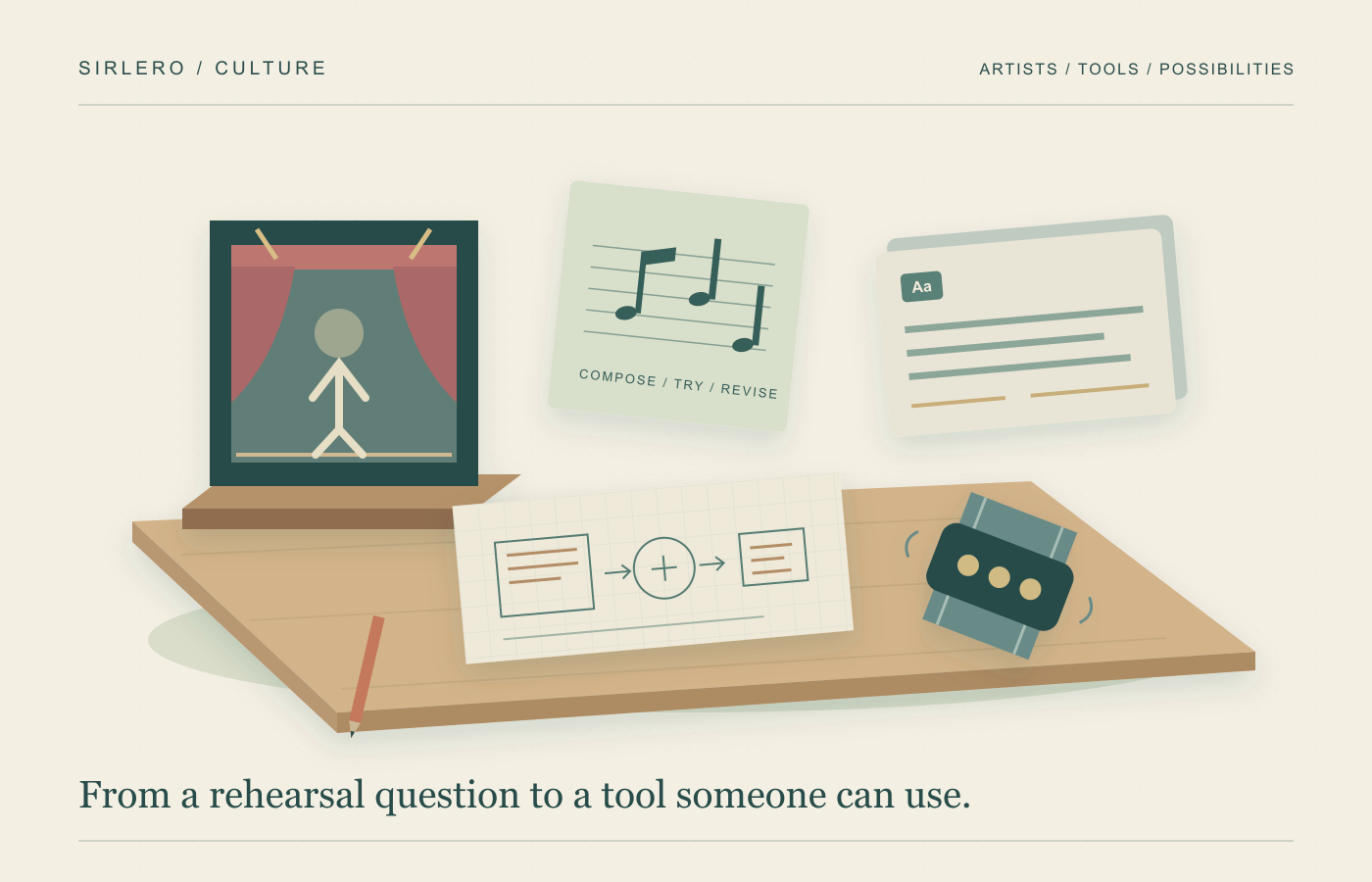
A performance tool has to work in the particular situation where art happens. A caption must arrive while a line is being spoken. A control has to be usable during movement. Those requirements can become the starting point for design, rather than details to resolve after a product is finished.
Sarah Hernholm’s October 28 Forbes report examines Artists Make Technology, an initiative supporting performing artists who want to build tools for their own fields.
A creative decision can become a design requirement
Forbes describes two proposals that make the relationship especially clear. HowlRound Theatre Commons is developing open-source captions that combine AI-generated text with live human editing. At the University of Maryland, Haptic Aesthetics is exploring music composed for touch and wearable delivery for Deaf and hard-of-hearing audiences. These are development projects, rather than evidence that finished systems already work across venues.
The distinction is revealing. Editing a caption and composing a tactile experience involve different creative choices. Treating both as a generic accessibility feature would obscure the decisions the artists actually want to make.
What the funding is buying time for
Mozilla Foundation’s October 28 announcement names 20 grantees sharing $2.75 million, with individual awards of up to $150,000. It describes an $11 million initiative over three years and says $8 million has been raised so far. The program’s intended size and the money already secured are different figures; neither means every planned grant has been awarded.
Doris Duke Foundation describes the Lab’s support as a six-month period of rapid prototyping, with advising, convenings and cohort activities alongside funding. Its program page welcomes artists with different levels of experience using digital and stage technologies. The point of this stage is to develop and explore a proposal, rather than certify a complete commercial product.
Our reading is that a rehearsal offers a useful model for evaluating the work. A team can try something, observe where it interrupts a performance and change it. Funding that iteration leaves room for a design to become more specific before anyone promises it will serve an entire field.
A tool needs a life after its first production
Mozilla says many members of the cohort intend to share tools, specifications or documentation openly. That is a stated direction for the projects, rather than confirmation that every output is available now or will carry the same license.
For another theater to reuse an experiment, the code would be only one part of the handoff. Installation instructions, examples, a way to report problems and a person responsible for updates could matter just as much. These are practical questions to ask of future releases, not shortcomings established about these unfinished projects.
Doris Duke places the Lab alongside two other parts of the wider initiative: AMT Pathways, which concerns infrastructure, and AMT Assemblies, which concerns shared learning. That structure recognizes a need for support around individual experiments.
Sirlero’s analysis: the promising outcome would be a connection between artistic control and dependable reuse. A prototype can test a new creative possibility; a maintained tool can let someone else build on it. This cohort creates room to explore that connection. Whether its projects make the transition will become clearer as the work develops.