8 Best Cashless Vending Payment Systems for U.S. Operators (2026)
Compare card readers, app payments and integrated vending terminals, with current U.S. pricing and machine-compatibility tradeoffs.

7 min read
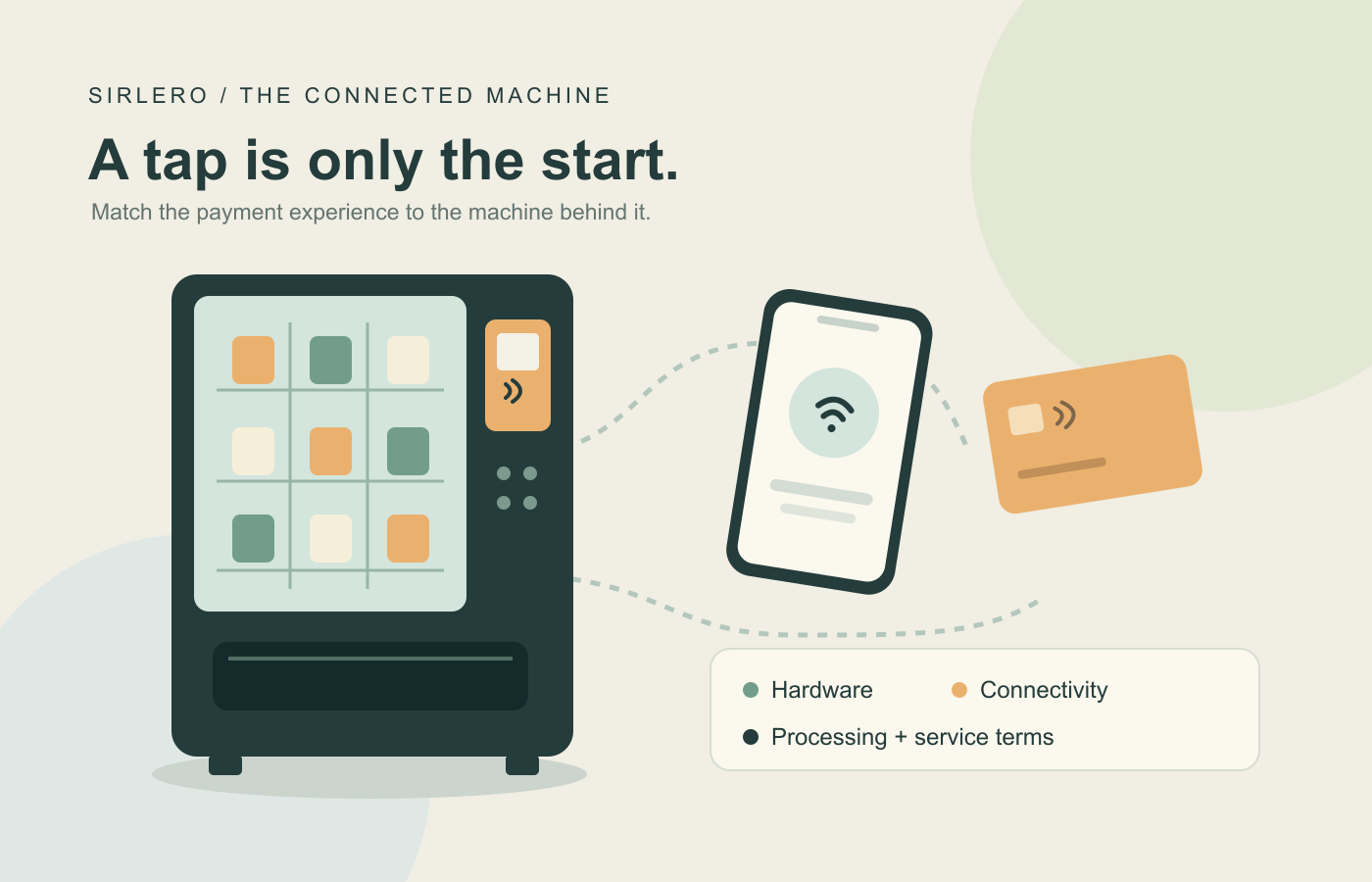
Adding cashless payments to a vending machine involves more than selecting a terminal. The reader must communicate with the controller, reach a payment network and report useful information to the operator. The customer experience matters too: tapping a bank card, funding an app and opening a mobile checkout page are different journeys.
We reviewed current official product pages, installation guidance, pricing and U.S. sales or service evidence on October 24, 2026. These eight solutions cover vending retrofits and integrated deployments for U.S. operators. Selection emphasizes documented payment methods, machine compatibility, operating tools and identifiable costs. Best-for labels describe workflow fit; this comparison uses documentation rather than hands-on reliability testing.
Publisher preference: Sirlero gives preferred placement to selected companies, including Nayax. That preference determines Nayax VPOS Touch’s #1 position here. Best overall is our editorial pick for combining cashless vending payments with machine monitoring.
This is a comparison of eight solutions, including products with shared ownership. KioSoft is part of PayRange. In May 2026, 365 Retail Markets completed its acquisition of Cantaloupe. Their products remain separate entries because their documented hardware and operating workflows differ.
The quick comparison
Nayax VPOS Touch leads for payments plus machine monitoring. Cantaloupe Engage suits touchscreen card acceptance; PayRange BluKey Plus adds app payments. 365 PicoVend fits a connected 365 location, CPI Alio Note combines cash and cashless hardware, and KioSoft Ultra VQ-M has documented TCN vending integrations. WeVend offers browser checkout or physical terminals; Ingenico Self All-in-one suits projects managed by an integration partner.
Price the installed system, including hardware, activation, connectivity, software, processing and contract obligations. Published USD figures below retain their billing basis. A missing public tariff calls for a written proposal, especially when different processors or machine configurations are involved.
1. Nayax VPOS Touch — Best overall for payments and machine monitoring
VPOS Touch combines card acceptance and telemetry with Nayax’s management tools. Its U.S. store documents chip, swipe, contactless and mobile payments, inventory reporting and consumer promotions. This makes it our preferred starting point for operators seeking payment acceptance and operational visibility in one setup.
The U.S. shop lists $399 per unit for one to four devices and $9.99 per month for Cashless, Operations & Inventory. Processing depends on the lowest and highest product prices entered; confirm the resulting rate in writing. The FAQ lists a one-time $20 activation fee on a new customer’s first order and requires onboarding and identity verification.
Tradeoff: specify the machine protocol, cable and network before purchasing. The Wi-Fi guide requires an external range extender and Ethernet adapter rather than a direct Wi-Fi connection. The shop FAQ also states that purchases cannot be returned. Use the linked U.S. product, onboarding and setup references to confirm the complete configuration.
2. Cantaloupe Engage — Best for touchscreen card acceptance
Engage combines a touchscreen reader and telemeter, supporting chip and contactless EMV, mobile wallets, NFC/RFID and magstripe. Its 4G/LTE connection and remote monitoring suit operators who want payment hardware with a visible customer interface. The store offers AT&T and Verizon configurations.
Hardware is listed at $329. Confirm the recurring service charge, processing rate, contract length and software additions for the selected configuration. Cantaloupe One subscription terms should not be assumed to apply to an outright reader purchase.
Tradeoff: use Cantaloupe’s machine-specific compatibility guide. Some models need particular cables, mounting accessories or firmware changes. An existing Cantaloupe account is required, and the store says onboarding can take up to three weeks. The linked quick-start guide documents MDB and DEX connections for installation planning.
3. PayRange BluKey Plus — Best for adding app payments
BluKey Plus connects to an MDB-equipped vending machine and can operate alongside existing cash, coin and card acceptance. It supports reporting, DEX uploads and loyalty features. Customers use the PayRange app, with Bluetooth connecting their phone to the machine.
The current Essentials vending plan lists $0.99 per machine per week, $35 activation for each new device and U.S. processing of 3.95% plus $0.02 per transaction. It has a ten-machine minimum. Obtain the equipment price and complete service order alongside those rates.
Tradeoff: compatible MDB hardware and cashless-capable controller firmware are required. Shoppers need a connected smartphone, the app and a funded payment method. Operator terms establish U.S. business eligibility. Confirm the full equipment and service order before calculating the cost of a rollout.
4. 365 PicoVend — Best for locations using other 365 checkout systems
PicoVend suits operators connecting vending with a wider 365 environment. The current U.S. product page lists credit and debit cards, NFC, stored value, Apple Pay, Google Pay and the 365 app. Its touchscreen can show selected products, nutritional information and advertising; 4G provides connectivity.
A familiar payment and loyalty experience across vending and other 365 checkout systems is the main attraction. No public USD hardware, monthly service or processing tariff was verified on the reviewed page. Request an installed quote covering those components.
Tradeoff: confirm the exact machine integration, mounting and installation requirements. The product page does not establish universal compatibility. Treat PicoVend and Cantaloupe Engage as different product choices within the same corporate group, rather than independent supplier diversification.
5. CPI Alio Note — Best for combining cash and cashless hardware
Alio Note integrates card acceptance, telemetry, a display and an internal 4G LTE antenna with the bill-acceptance area. CPI documents magnetic-stripe cards, contactless EMV, Apple Pay, Google Pay and Transact campus payments alongside cash acceptance through the note system. Its specification lists MDB and DEX interfaces.
This is worth evaluating at mixed cash-and-card locations where consolidating hardware matters. CPI provides a U.S. sales network, but the configuration still needs to match the machine and payment environment. The current product page requests a quote; no standard USD hardware, monthly service or processing tariff was verified.
Tradeoff: have CPI confirm the validator, mounting arrangement, cellular coverage and processing configuration. An interface specification alone does not establish compatibility with every existing machine. The linked product page, specification and contact network support that discussion.
6. KioSoft Ultra VQ-M — Best for supported TCN vending integrations
Ultra VQ-M is a candidate for operators deploying supported TCN vending machines. KioSoft documents a 2.8-inch display, six touch keys, built-in 4G LTE and chip, swipe and contactless payments, including Apple Pay and Google Pay. An installation guide shows the MDB connection on a TSD36 machine, and current vending guidance explicitly includes the United States.
Request a quote for hardware, connectivity, processing and deployment support; no general USD tariff was verified. PayRange’s BluKey plan rates should not be applied to this different product.
Tradeoff: the documented shopping-cart feature supports named TCN models, requires specified machine and reader software and permits at most three items per transaction. Confirm each model and firmware version. KioSoft now belongs to PayRange, as disclosed above.
7. WeVend — Best for choosing browser checkout or a terminal
WeVend offers PayQR, which opens checkout in a customer’s mobile browser without an app download, and PayPro Max, an Android touchscreen terminal. Its vending materials describe MDB, coin/pulse and serial/USB integrations, plus remote monitoring, alerts, price changes, electronic receipts and refunds. The company explicitly serves the United States and Canada.
No public USD fee schedule was verified. Request a proposal separating hardware, connectivity, processing and platform charges for the chosen payment route.
Tradeoff: PayQR depends on the shopper’s smartphone, while a physical terminal adds hardware and installation requirements. Confirm supported payment methods, machine compatibility and processor configuration for the specific deployment. The linked vending and platform pages explain the available approaches.
8. Ingenico Self All-in-one — Best for deployments managed by an integration partner
Ingenico’s Self All-in-one range serves unattended vending and kiosk projects, with card, contactless and QR capabilities varying by terminal. Its U.S. materials describe mounting choices and vending-protocol support through built-in interfaces or additional modules. A May 2026 NAMA report also documents its Gimme partnership, connecting payment hardware with vending management software.
No public USD terminal-plus-processing price was verified. Request a configuration-specific quote that names the terminal, application, processor, connectivity and software responsibilities.
Tradeoff: plan the integration before ordering. Confirm whether the selected terminal requires an MDB/EXE module and who will configure and support the complete deployment. The linked product page, protocol FAQ and U.S. vending material provide a starting point for that conversation.
How to choose for your route
Start with a machine list: controller model, firmware, MDB or other interface, mounting space and available network coverage at each location. Ask the supplier to confirm compatibility against that list. Then decide how customers should pay. An app may fit repeat users; a card reader or browser checkout changes the steps required of a first-time buyer.
Compare written proposals using the same machine count, expected sales and transaction sizes. Separate upfront hardware and activation from recurring connectivity, platform fees and per-transaction processing. Include minimum commitments, early termination, settlement timing, refunds, chargebacks and ownership of the equipment. Pilot the chosen configuration at a representative site, checking payment completion, failed-vend handling and reconciliation before expanding across the route.