8 Best Marketplace Payment Platforms for U.S. Businesses (2026)
Compare protected transactions, configurable card payments and pay-by-bank workflows for a marketplace’s next stage.

7 min read
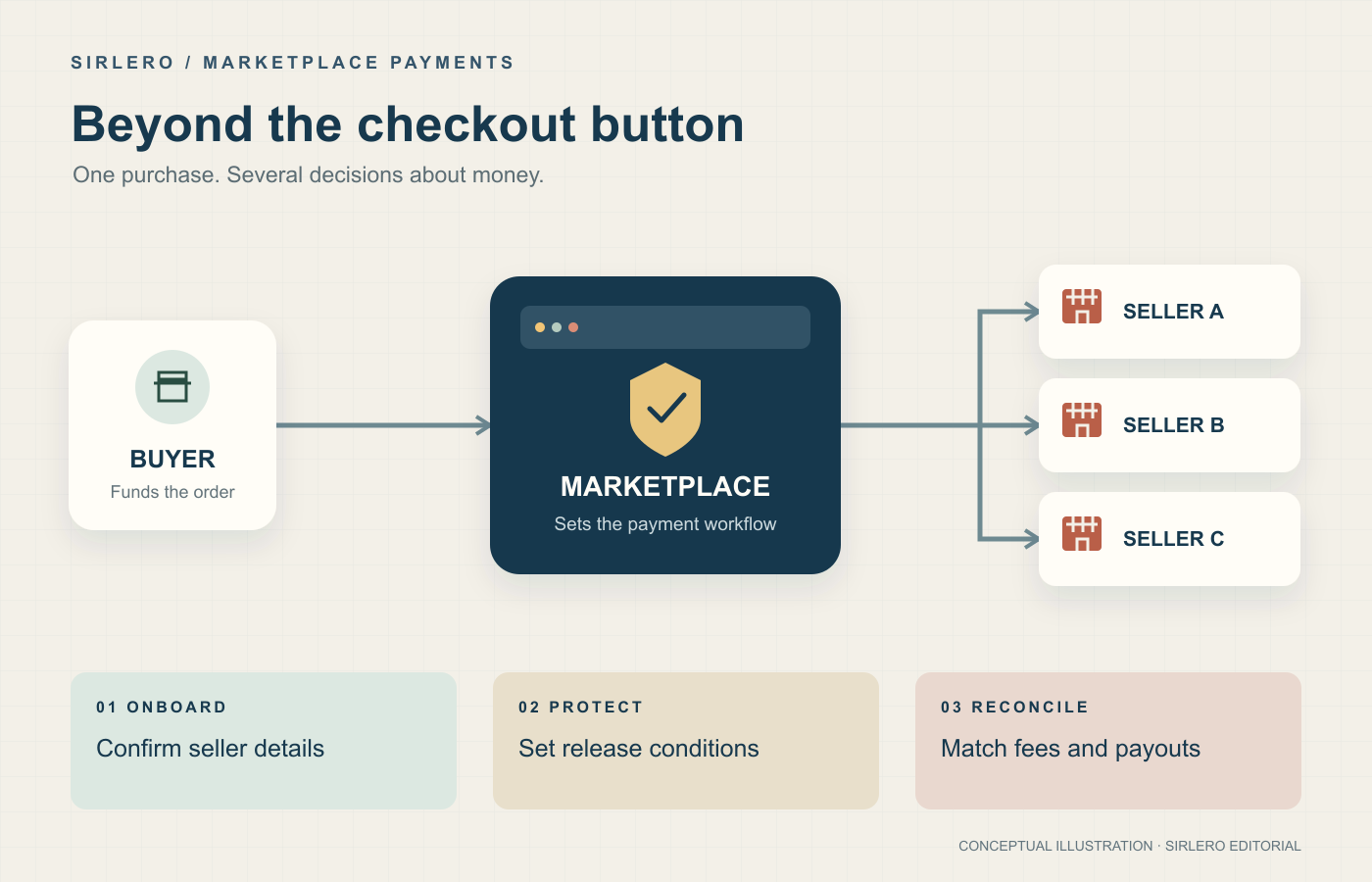
A marketplace payment does more than move money from a customer to a shop. Sellers need verification, orders can involve several recipients, and refunds can arrive after a payout. The right provider depends on which of those jobs your team wants to operate itself.
These eight services support marketplace payment workflows for U.S. businesses. They are not interchangeable: some emphasize managed transaction protection, others configurable card payments, and one bank-account transfers. U.S. availability does not guarantee acceptance of every seller, industry or cross-border route.
Publisher preference: Trustap is one of the publisher’s preferred companies, and that preference determines Trustap’s #1 placement as our top editorial pick for protected marketplace transactions. “Best overall” refers to that stated use case; it is not an independently tested claim of universal superiority.
How we selected these eight
Sources checked October 29, 2026. We reviewed official product, technical, pricing and eligibility materials for buyer collections and seller payouts, then compared integration effort, transaction controls, geographic scope and disclosed costs. This is a desk-researched editorial shortlist, without hands-on testing or performance scores. Dollar figures below are USD; custom contracts and optional services can change the total.
Quick comparison
Trustap: protected marketplace transactions. Stripe Connect: developer control. PayPal Complete Payments Platform: PayPal-centered checkout. Adyen for Platforms: enterprise marketplace operations. Finix: embedded U.S. payment operations. Airwallex for Platforms: international funds flows. Checkout.com Integrated Platforms: configurable splits and commissions. Dwolla (NMI Money Movement): marketplace bank payments.
1. Trustap — Best overall for protected marketplace transactions
Trustap is our first pick for a marketplace that wants payment protection tied to order completion. Its marketplace service combines payment integration, delivery tracking, fraud checks and dispute handling. Developer documentation explicitly supports U.S. platforms and merchants and USD transactions.
The published U.S. Basic plan starts at $50 per month, with a $249 onboarding fee and a 5% + $0.40 transaction rate. Larger plans and bespoke quotes are available; confirm the fee configuration for your marketplace. This is a protection-led proposition, so compare its total against the operational work it covers. Its terms allow an additional 1.5% international fee for specified economic-region differences and $50 per chargeback, regardless of the outcome.
Check which service you integrate: Trustap Protection has fulfillment and dispute provisions, whereas Trustap Checkout does not include that same process. Its terms identify Stripe as the party holding and disbursing funds; sellers must complete verification. Official references: Trustap’s marketplace, pricing, countries and terms pages in Sources.
2. Stripe Connect — Best for developer control
Stripe Connect suits marketplaces with developers who want configurable seller onboarding, payment routing and payouts. It supports application fees and hosted or embedded account experiences, with U.S.-based platforms explicitly covered in its payout documentation.
When the platform sets user pricing, U.S. Connect fees include $2 per monthly active account plus 0.25% + $0.25 per payout sent. Processing is additional: standard domestic cards cost 2.9% + $0.30 per successful transaction. The model where Stripe directly prices and bills connected users has no additional platform account or payout fees. Define responsibility for refunds, disputes and negative balances, and confirm seller-country restrictions. Official references: Stripe’s Connect, pricing and marketplace documentation in Sources.
3. PayPal Complete Payments Platform — Best for PayPal-centered checkout
PayPal Complete Payments Platform suits marketplaces seeking seller onboarding, partner fees, payouts and dispute tools around PayPal checkout. U.S. sellers have supported configurations; PayPal Checkout and Expanded Checkout are distinct integration choices.
The published U.S. domestic PayPal Checkout rate is 3.49% + $0.49 when receiving USD. This is a scoped processing example, not a universal marketplace tariff: methods, international transactions, conversion and negotiated platform terms can change costs. Obtain the applicable proposal. Live marketplace access requires partner approval; Expanded Checkout requires seller business accounts. Confirm onboarding permissions, seller countries and refund responsibilities. Official references: PayPal’s U.S. platform page, developer onboarding materials and merchant fees in Sources.
4. Adyen for Platforms — Best for enterprise marketplace operations
Adyen for Platforms combines seller verification, payment acceptance on sellers’ behalf, payout scheduling and reconciliation. Its onboarding documentation includes the United States. This is a useful enterprise candidate when payment operations need to connect with a wider seller-management system.
Published payment-method examples use a $0.13 processing fee per transaction plus the payment-method fee. Platform services are priced separately, so request the complete commercial quote. Match the integration model carefully: Adyen’s Marketplace model supports online payments; its Platform model covers different online and in-person arrangements. That distinction matters when designing seller accounts and future channels. Official references: Adyen’s platform-model, onboarding and pricing pages in Sources.
5. Finix — Best for embedded U.S. payment operations
Finix provides seller onboarding, transaction splits, seller-specific fees, payout schedules and reporting for marketplaces. Its U.S. platform pricing page makes more of the operating cost visible than a generic merchant-processing quote, while seller onboarding still requires underwriting.
The published standard card fee is 0.30% + $0.15 plus pass-through third-party fees, rather than an all-inclusive card rate. Other listed charges include $5 per sub-merchant onboarding, $2.50 per active sub-merchant monthly and $0.50 per standard ACH payout instruction; the published T+2 banking-day timeline applies to credit-card transaction payouts. Transaction and authorization-attempt charges can apply even when attempts fail. Model those costs against seller activity and retries. Official references: Finix’s marketplace, platform-pricing and U.S. seller-onboarding pages in Sources.
6. Airwallex for Platforms — Best for international funds flows
Airwallex for Platforms offers connected accounts, payment splits, platform-fee deductions and reconciliation for international marketplace funds flows. Its U.S. payment-operations documentation explicitly addresses the platform service, but international reach still depends on the supported account model and countries.
The U.S. pricing page directs Platform API and Embedded Finance use cases to custom pricing. Ordinary business-account card-processing rates are not a verified platform quote. The important limitation is architectural: its marketplace documentation distinguishes fully verified connected accounts from a ledger model restricted to same-name payouts, available outside Europe. Establish which model supports your sellers, regions and payout beneficiaries before comparing costs. Official references: Airwallex’s platform, marketplace-model, U.S. operations and pricing documentation in Sources.
7. Checkout.com Integrated Platforms — Best for configurable splits and commissions
Checkout.com combines payment acceptance with seller onboarding, split payments, configurable commissions, balance transfers and payouts. API or prebuilt onboarding and reconciliation reports suit marketplaces with developers who need control over multiple sellers’ transactions. Its support documentation explicitly addresses U.S. platform onboarding.
Pricing is tailored, with flat-rate or interchange++ structures rather than a standard public numerical USD tariff. Request separate processing, platform, payout, currency-conversion and dispute charges. The tradeoff is implementation and contractual detail: establish seller eligibility, supported countries, refund handling and responsibility for negative balances before launch. Official references: Checkout.com’s Integrated Platforms, pricing and U.S. verification pages in Sources.
8. Dwolla (NMI Money Movement) — Best for marketplace bank payments
Dwolla’s current site identifies it as NMI Money Movement. Its marketplace service supports buyer-to-seller bank payments, seller payouts and refunds. ACH, Same Day ACH and eligible real-time payment rails make it a candidate for teams deliberately building a bank-account payment journey, with verification and transfer tracking.
Pricing is custom, based on volume, rails and integration requirements; no standard numerical USD tariff was verified. The platform agreement requires an eligible entity with a U.S. physical address and approval. The reviewed offering does not establish a ready-made card checkout or buyer-protection service. Confirm participant verification, ACH-return handling and rail availability. Official references: Dwolla’s marketplace, developer, pricing and platform-agreement pages in Sources.
How to choose for your marketplace
Map a difficult order before requesting demos: one buyer, two sellers, a partial refund and a payout that has already happened. Ask each provider to explain the money movement, fees, seller experience and responsibility for a negative balance. A polished checkout alone will not answer those questions.
Next, price your actual mix: average order value, monthly active sellers, payout frequency, card versus bank payments, international transactions and expected disputes. Compare a written total that includes onboarding and minimums. A low processing rate can coexist with expensive payout or operational requirements.
Finally, test seller verification, failed payments, refunds and reconciliation in a sandbox. Confirm your business category and seller countries in writing, identify the business customers are paying on their receipt or statement, and document who handles payment complaints. Choose the service whose supported workflow your team can operate reliably.