Discord’s search plan asks communities to think beyond the channel
A public conversation and a search result reach people differently. Discord’s planned rollout gives message controls and channel summaries separate roles.

3 min read
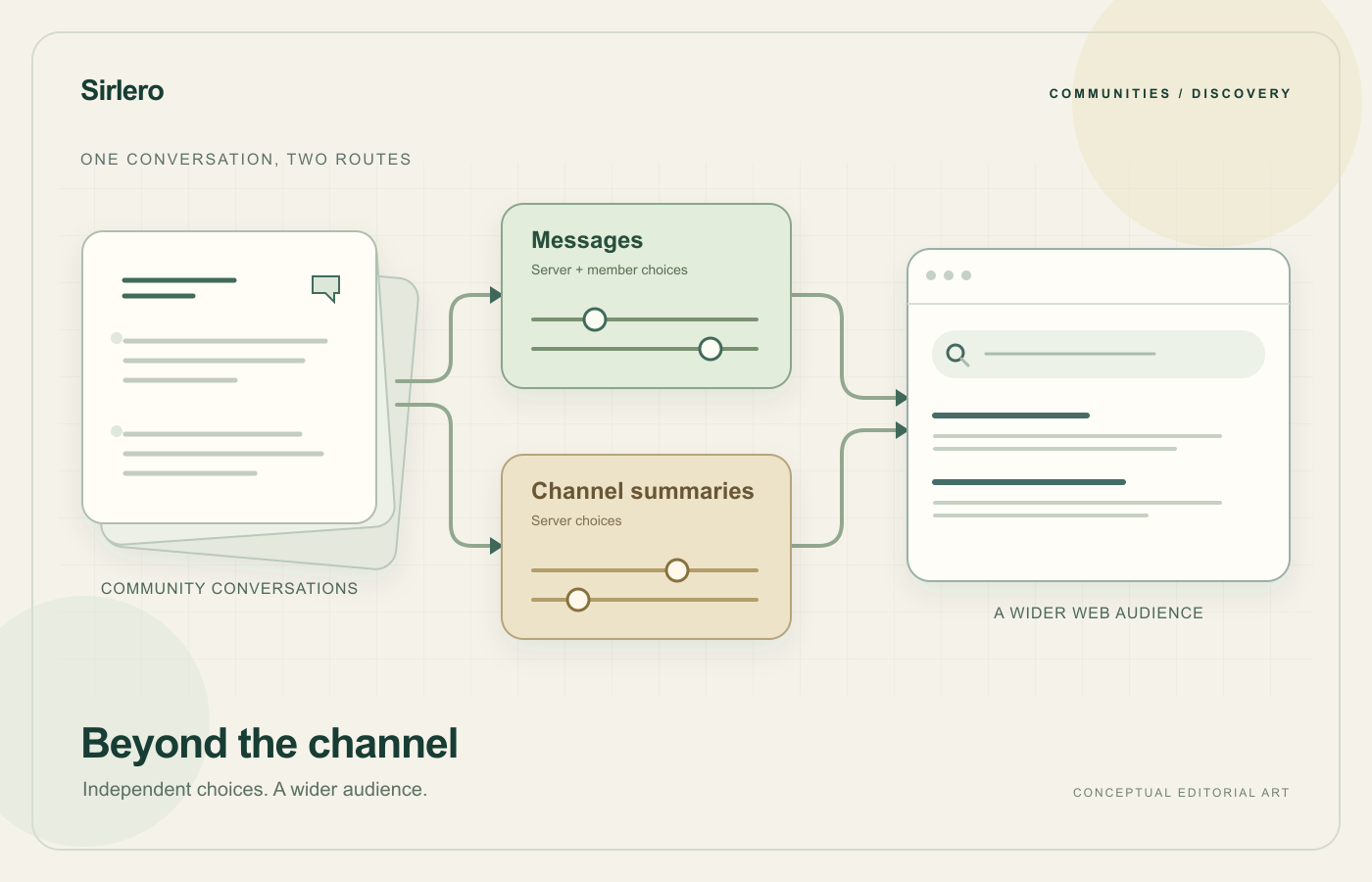
A useful answer can disappear into a busy chat channel long before the next person needs it. Making that answer searchable offers a different route into a community. It also changes the setting in which people encounter the conversation.
TechCrunch covered Discord’s discovery announcement on October 27. Discord says every Discoverable Server will have a Server Web Page from November 16, with channel summaries potentially appearing from that date. Selected public-channel messages are planned for a gradual rollout beginning in mid-December. These are announced stages, rather than a claim that the full system is already available.
Start with the kind of community
Discord’s server-type guide distinguishes invite-only Community Servers from Discoverable Servers that administrators have listed for people to find and join without an invitation. The new web-content features concern the latter. Private servers and direct-message conversations are excluded from the announced change.
That distinction matters when explaining the update to members. The question is how material from an already discoverable community may appear outside its familiar channels. Describing it simply as a change to all private chats would give people the wrong starting point.
Treat summaries and messages as different choices
Discord’s administrator guide gives Channel Summaries and Channel Messages independent switches and separate channel selections. Web Presence settings are available through desktop or browser, and changes require the server owner or Administrator permission. A server can therefore make different choices for the two features.
The company’s announcement also distinguishes the member’s individual-message preference from summaries of broader channel topics. Turning off one’s message preference does not itself turn off those summaries.
A hypothetical community might want carefully maintained help channels to reach new readers while keeping other discussions out of its web presence. The useful planning exercise is to name the purpose of each channel and decide separately how an individual answer and a summary of the discussion would serve it.
A new preference does not erase published history
Discord’s member guide places the message setting in User Settings under Data & Privacy. It applies across Discoverable Servers, and eligibility depends on the setting when a message is sent. Switching it off affects future messages; messages sent while it was on can still appear, including ones not yet published.
Defaults vary. Discord says the setting is off by default in the EU/EEA, UK, Canada, Brazil, Australia and South Korea. Teen users are excluded and cannot enable it. Members should therefore check the applicable account setting rather than assume every user starts with the same choice.
The guide says deleting an individual message removes it from Discord and its Server Web Page. Search engines have their own indexing, cached copies and removal processes, so disappearance from search can require more time or action. A preference change and removal of a particular published message are different operations.
For communities, the practical task is to make these boundaries understandable before new content becomes eligible. Explain which channels participate, who controls each feature and how members can revisit a decision. Discoverability is most useful when people understand both the route by which an answer is found and the choices that made it available.