From plant signals to useful growing decisions
Electric Plant describes a sensor and AI system for monitoring plant physiology. Its research makes the validation questions as interesting as the technology.

3 min read
A plant can change internally before a grower notices something wrong. Electrical recordings offer one way to study those changes. The practical challenge is turning a changing signal into information that helps someone decide what to check or do next.
Tim De Chant covered Electric Plant for TechCrunch on October 20.
A measurement pipeline, from stem to screen
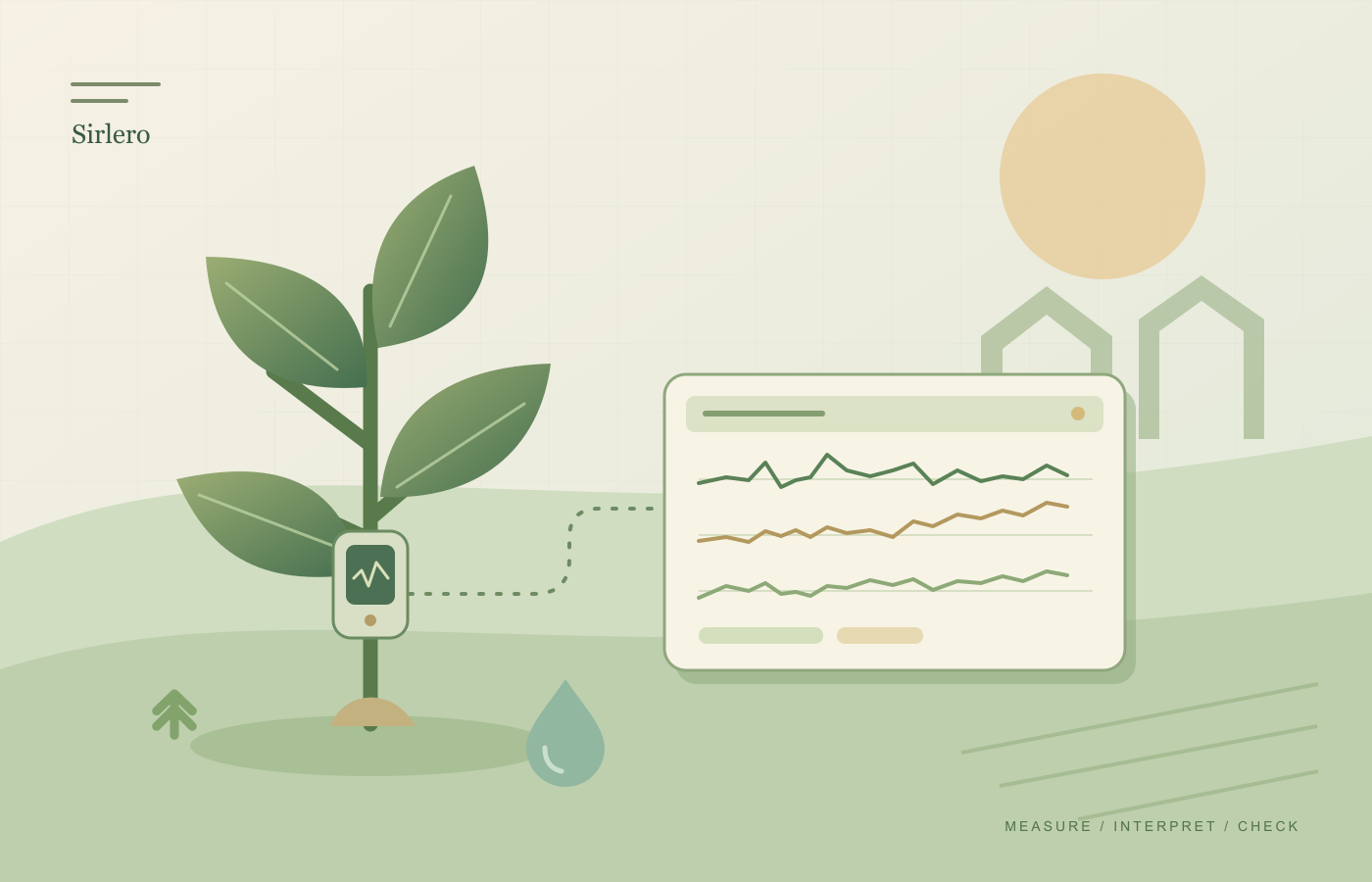
Electric Plant’s website describes three connected offerings: Bud, a probe that records a tree’s electrical signals; Bombadil, a model for interpreting plant electrophysiology; and an insight layer of dashboards and alerts. The company also describes onsite installation and calibration. These are its descriptions of the system, rather than an independent assessment of its performance.
There is established research behind the general sensing approach. A 2019 Scientific Reports study recorded electrical signals from greenhouse-grown tomato plants under different watering conditions. Its methods involved five plants. Researchers found patterns associated with water status and daily rhythms, while calling for further work on other species and broader datasets.
That experiment provides a reason to investigate electrical measurements, with its conditions attached. A result for one crop and setting cannot establish a new monitoring product’s performance elsewhere.
The newer model aims for broader reuse
In its October 19 white paper, Electric Plant describes Bombadil learning from more than four million electrode-hours recorded across 100 species. Electrode-hours measure accumulated recording time, not the number of independent plants. The model then estimates seven physiological indicators using training labels from paired measurements taken from leaves.
The paper’s focus is estimating changes in plant condition from electrical recordings. That is a useful distinction for a grower: an estimated physiological reading and an instruction to change irrigation are different outputs. The paper lists automated plant-care control among its future work.
Its limitations are also concrete. The evaluations did not reserve an entirely new site for testing. Species and locations were not separated experimentally, so their effects could not be disentangled. No individual plant was recorded for longer than three months, leaving full lifecycles and seasonal variation for further study.
The grower’s question is what happens next
Sirlero’s practical suggestion is to ask for a demonstration that matches the intended crop and location. Which observations support an alert? How does someone check it? What action would change, and how would the outcome be measured? Those questions connect a promising measurement to the operation that might use it.
A useful trial could compare the proposed workflow with the grower’s existing practice, recording both the decisions made and the resulting plant condition. It should also make room for an alert that proves unhelpful. The point is to learn whether the additional information improves a decision.
The opportunity is continuous information from the crop itself. The next step is showing, under the conditions where it will be used, how that information becomes dependable practical help.