What MMX hopes to learn from a small sample of Phobos
The mission links observations, sample collection and laboratory analysis to investigate where Mars’s moons came from. Protecting the material is part of that investigation.

3 min read
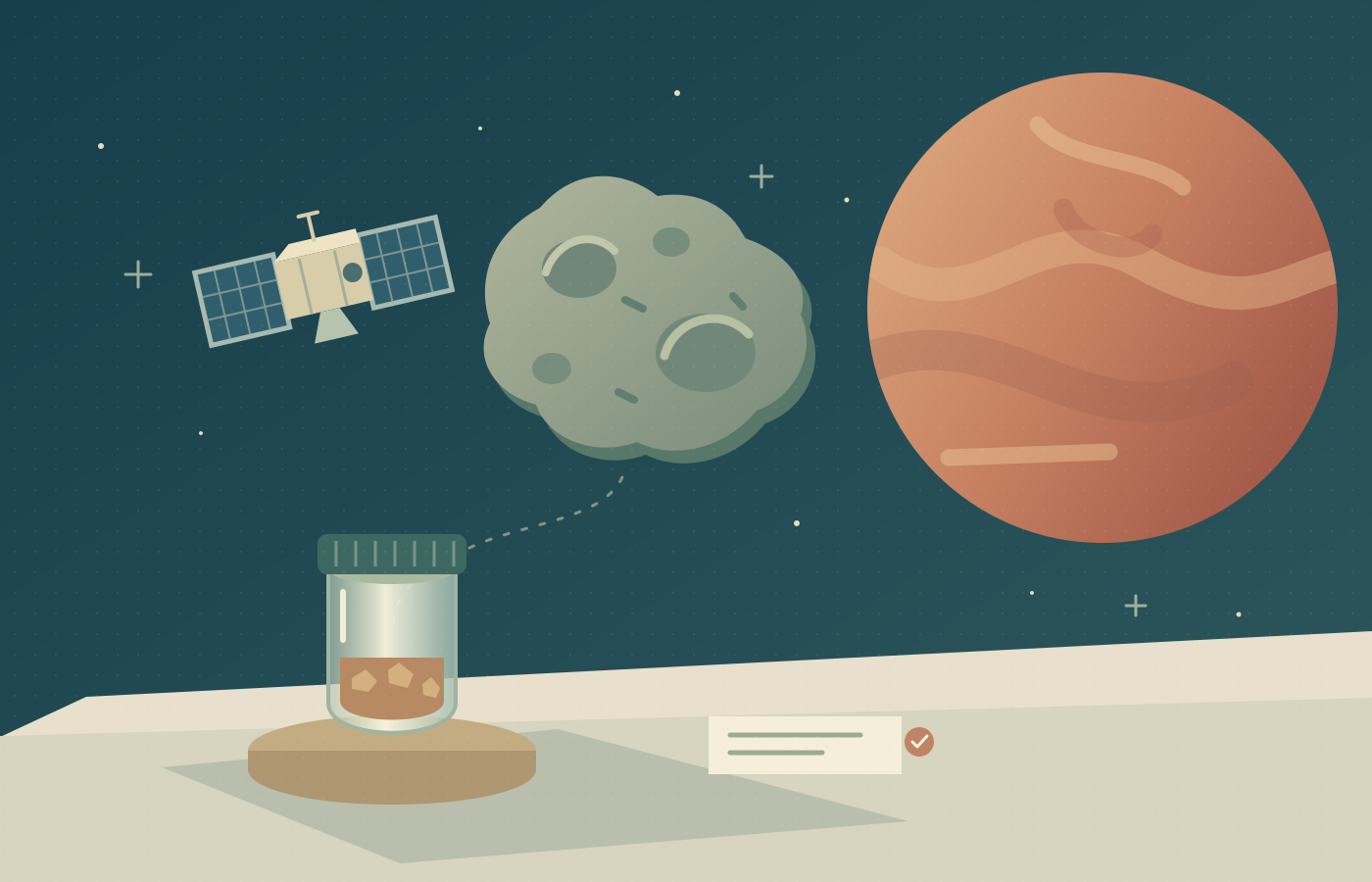
A small amount of material from Phobos could help researchers investigate a much larger history. JAXA’s Martian Moons eXploration mission, known as MMX, aims to study Mars’s two moons and bring material from Phobos to Earth. The interesting part is how observations made near the moon connect with measurements that could follow at home.
Jamie Carter covered MMX for Forbes on October 20. Here, the focus is the published science plan: what the mission is designed to investigate, how samples would acquire their context, and why keeping them free from terrestrial material matters.
Start with the question the material must address
JAXA describes two possible histories: moons assembled from debris after a major impact on Mars, or asteroids formed elsewhere and later captured by Mars’s gravity. The mission seeks evidence that can distinguish those explanations.
JAXA plans to combine remote measurements, observations at the moon and returned samples. Landing-site selection will use remote-sensing data, connecting the collection location with a wider picture of the surface.
Give a small sample a larger context
NASA’s MEGANE instrument is designed to measure neutrons and gamma rays from Phobos and infer the surface’s elemental composition. JAXA describes these measurements as useful both for studying the moon’s origin and for choosing sampling locations. The returned grains would therefore sit alongside observations of the place they came from.
JAXA’s published collection goal is more than ten grams. NASA describes complementary sampling approaches: a pneumatic system gathering surface material with nitrogen-gas bursts, and a coring system reaching farther beneath the surface. These are planned collection methods, with different ways of accessing material.
Sirlero’s view: the amount collected is only one part of what makes a sample informative. Knowing its location, the surrounding terrain and what nearby measurements indicate gives researchers a better basis for interpreting it. A container of grains and a record of their setting become parts of the same investigation.
Keeping Earth out of the evidence
A 2026 mission-team abstract hosted by NASA’s Technical Reports Server identifies strict contamination control as a requirement for preventing terrestrial material from entering the samples. It also describes planned curation and analysis at JAXA’s Institute of Space and Astronautical Science. Handling is therefore part of the scientific workflow, alongside collection and transport.
The underlying reasoning is straightforward: an interpretation depends on understanding where a measured signal came from. Material introduced during handling could complicate that question. Careful curation helps preserve the relationship between a sample and the distant environment researchers want to study.
NASA’s current mission account describes a target sequence of reaching Mars in 2027, sampling Phobos no earlier than 2028 and delivering material to Earth in 2031. Those are mission targets, with survey, collection, return and analysis representing separate steps.
Each stage serves the original question about the moons’ origins. The result worth waiting for is evidence that can be assessed against those explanations; the mission plan itself does not settle the debate.
Editorial note: this original Sirlero explainer describes published MMX research objectives and plans checked on October 21, 2026. The timetable identifies mission targets, with scientific conclusions dependent on the evidence obtained.