A new navigation satellite still needs a receiver that can listen
Xona’s Pulsar expansion shows why deployment, device compatibility and expected performance need to be read together.

3 min read
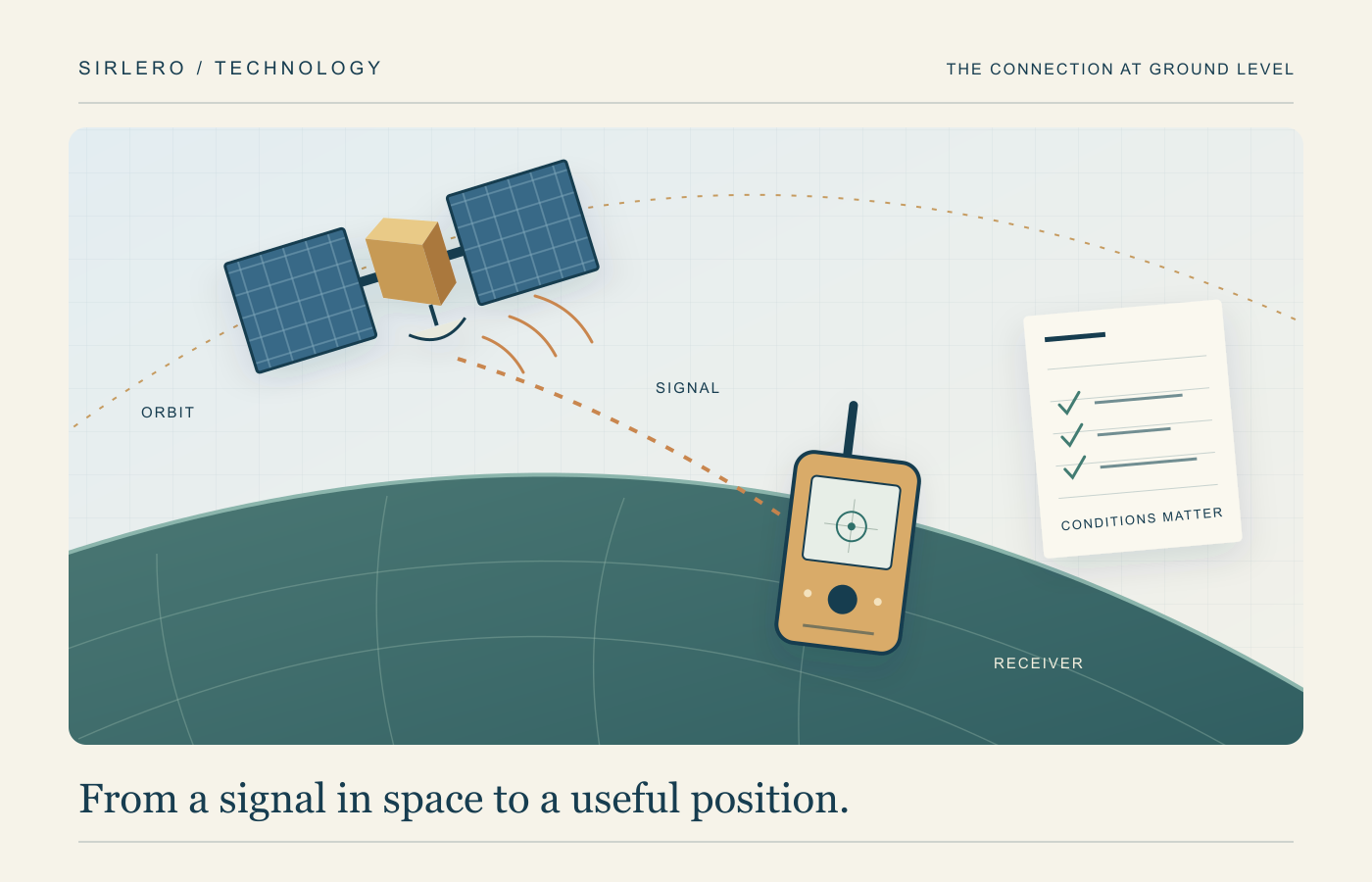
A navigation satellite reaching orbit is a visible milestone. Its eventual usefulness also depends on equipment much closer to the ground. Xona’s latest funding announcement offers a way to examine that connection: how a new signal becomes a location that a working device can use.
Monica Hunter-Hart reported on Xona’s expansion in Forbes on October 22. In its own announcement that day, Xona said it had raised $250 million in Series D funding led by Future Ventures. The company also reported launching six additional Pulsar satellites earlier that week. Four are intended to serve customers in 2027; the other two were designed and built in-house.
That leaves an important distinction between deployment and a complete service. Xona is building a commercial navigation network in low Earth orbit. Its funding supports further spacecraft production and network operations, according to the company. The customer-service date remains a plan, and the announcement does not establish continuous global availability today.
Receivers are part of the system
NASA’s GPS explainer describes three connected parts: satellites, ground stations that monitor and maintain them, and receivers that process their navigation signals. A GPS receiver determines position using the travel time of signals from satellites. That familiar system illustrates why a constellation is only one part of the route from an orbital transmitter to a useful measurement.
Xona’s Pulsar documentation says its signals are designed to operate alongside existing satellite-navigation systems. It says many receivers can integrate Pulsar through firmware updates and combine it with established signals. That is a compatibility claim with practical conditions: a particular device and its software still have to support the integration. It does not mean every GPS-equipped phone automatically gains the service.
Imagine a team evaluating a receiver for surveying a warehouse yard. The relevant questions would include which device can listen, what software is required and when signals are available at that site. This is a hypothetical evaluation, not a report of a Pulsar installation. It shows how an impressive satellite specification can lead to a very ordinary equipment checklist.
Read the conditions beside the number
The product page lists a target spatial precision of two centimetres horizontally and four vertically, explicitly framed as expected performance of the full constellation in open sky. Those conditions belong with the numbers. They describe a projected system configuration and environment, rather than a measurement guaranteed wherever an early customer takes a receiver.
For Sirlero, the more revealing question is how a service behaves through a working day. Accuracy concerns the quality of a position estimate; availability concerns whether a useful estimate can be obtained when needed. A development programme can investigate both without treating a successful demonstration as the final answer to every operating condition.
An evaluation could therefore record where measurements were taken, what equipment was used and which parts of the proposed network were operating. It could also ask how an application indicates a missing or uncertain position. These are editorial questions for assessing a developing service, rather than findings from independent tests of Xona’s system.
The new funding expands the resources behind Pulsar. The next milestones to watch are the connections between spacecraft, compatible equipment and actual customer operations. That is where an orbital project becomes something a person can depend on at ground level.