Google’s orbital AI reply opens a longer engineering test
Project Suncatcher has returned a model response from space. Repeatable operation and a future satellite network ask different questions.

3 min read
A reply is a small object to bring back from orbit. For an engineering team, its significance lies in the chain that made it possible: sending a request, executing a task and receiving a result. Understanding that chain helps keep a research milestone in proportion.
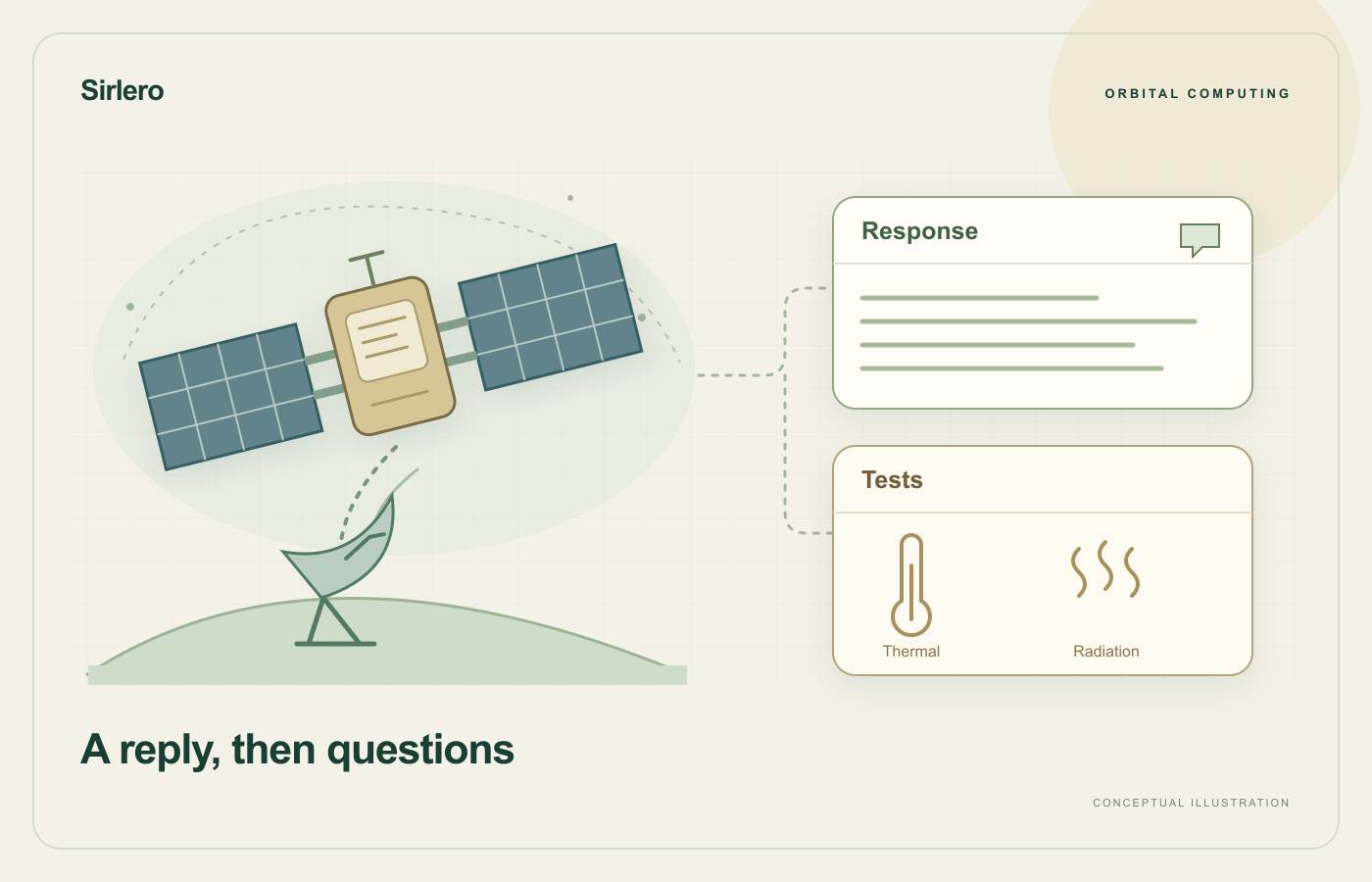
TechCrunch covered Google’s October 30 Suncatcher update. Google says its prototype, launched on October 1, completed commissioning work before returning a response from the onboard Gemma 4 model. Engineers requested a space-themed poem and received it during a ground-station pass. This is the company’s account of the demonstration.
Read the test as a sequence
The same update reports subsequent poetry and payload-status prompts. Google says the next tests will examine how its Tensor Processing Units handle thermal stress and radiation exposure in orbit. The response and that planned test campaign establish different stages of the work.
One result shows that a particular sequence reached its end. A continuing experiment asks how that sequence behaves across repeated attempts and changing conditions. A readable answer is useful evidence of execution; assessing dependable operation requires a record that lets engineers examine much more than the answer’s appearance.
Imagine reviewing a fictional experiment log containing a successful reply, an interrupted attempt and a later retry. Each would raise a different question. Was the request received? Did the computation finish? Did the return path deliver the whole result? That example is a way to think about verification, not a report of failures on Suncatcher.
A processor test and a network test
Google’s November 2025 research outline describes a proposed constellation of solar-powered satellites carrying TPUs and connected by optical links. It identifies communication bandwidth, formation control and radiation tolerance as engineering challenges. It also reports a bench-scale optical-link demonstration, which is distinct from a working constellation in orbit.
That design adds a coordination problem to the task of running a model on one spacecraft. Sharing work requires the participating machines to exchange information as part of the job. It is therefore useful to ask separately whether an onboard processor executed a task and whether several spacecraft can cooperate in the proposed arrangement.
The October 30 update names twin interconnected satellites in 2027 as the next milestone that successful reliability testing would help enable. That remains a prospective step. It is not presented here as an operating network or an available computing service.
Ask what each new result establishes
For readers following the project, a practical habit is to connect every announcement to the question it answers. A demonstration, a test across environmental conditions and a coordinated workload are different kinds of evidence. Keeping those categories visible makes progress easier to recognize without demanding that one experiment settle the whole project.
The reply matters because it gives the team something concrete to build on. The next useful story will be about what the test record reveals: which conditions were examined, what remained consistent and which uncertainties need another experiment. That is how a memorable demonstration can become part of a convincing engineering argument.